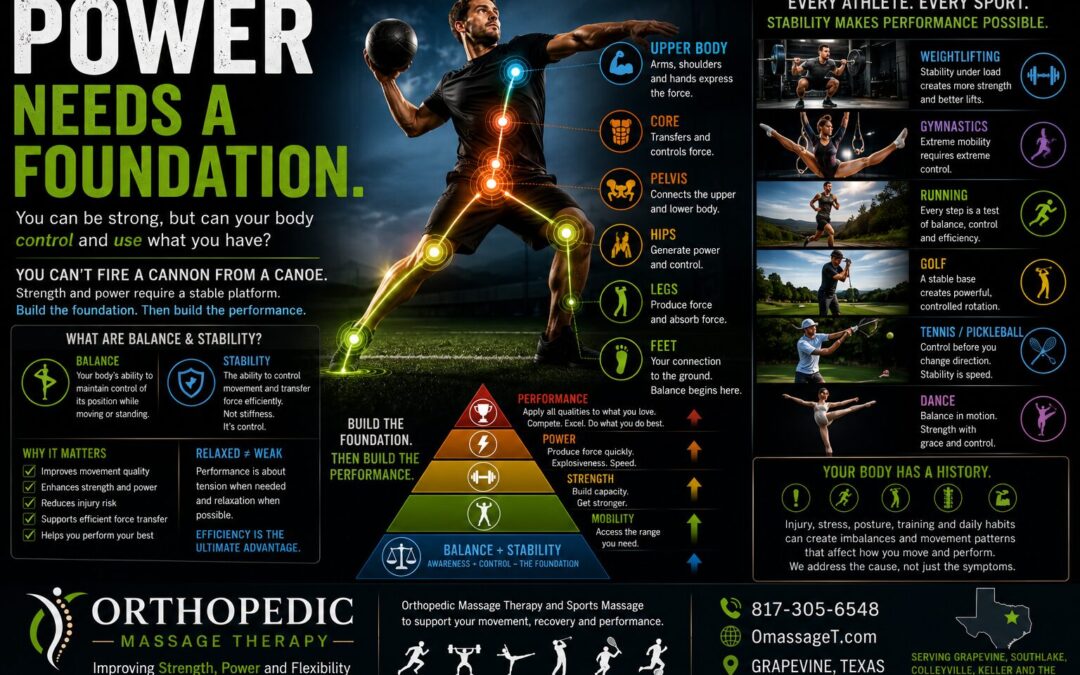
The Power of Core Performance: More Than Strong Abdominal Muscles
When people hear the word “core,” they often think about six-pack abdominal muscles, sit-ups, planks, or holding the stomach tight.
Core performance is much bigger than that.
The core is a coordinated system involving the diaphragm, abdominal wall, pelvic floor, lumbar spine, pelvis, hips, gluteal muscles, and surrounding fascia. These structures help the body breathe, balance, stabilize, rotate, transfer force, and respond to movement.
For athletes, core performance connects the strength of the lower body with the movement of the upper body. For non-athletes, it supports everyday activities such as walking, standing, sitting, reaching, bending, lifting, and getting out of bed.
At Orthopedic Massage Therapy in Grapevine, Texas, I look at the core as part of a larger movement system. My goal is not simply to make the abdominal muscles tighter. It is to help the body become more balanced, coordinated, mobile, stable, and prepared to produce strength and power.
What Is the Core?
The core is not one muscle.
It includes a group of muscles and connective tissues surrounding and supporting the trunk, spine, pelvis, and hips. Important structures may include:
-
Diaphragm
-
Pelvic floor
-
Abdominal wall
-
Transverse abdominis
-
Internal and external obliques
-
Rectus abdominis
-
Multifidus
-
Erector spinae
-
Quadratus lumborum
-
Iliacus
-
Psoas
-
Gluteal muscles
-
Hip rotators
-
Thoracolumbar fascia
These structures do not work independently. They coordinate with the rib cage, lumbar spine, pelvis, hips, shoulders, and legs.
A review of core-stability principles describes the core as the group of trunk muscles surrounding the spine and abdominal area, with the abdominal, gluteal, hip-girdle, and paraspinal muscles working together to support spinal stability.
A powerful core is not simply rigid. It can create stability while still allowing movement.
Core Strength and Core Performance Are Different
A person can have strong abdominal muscles and still struggle with core performance.
Someone may be able to hold a long plank but have difficulty rotating through the hips and thoracic spine. Another person may lift heavy weights but hold the breath or overuse the lower back during movement.
Core strength describes the ability of muscles to produce or resist force.
Core performance includes:
-
Strength
-
Coordination
-
Balance
-
Stability
-
Mobility
-
Breathing
-
Timing
-
Endurance
-
Force transfer
-
The ability to relax when tension is unnecessary
The strongest contraction is not always the best response. Sometimes the body needs to stabilize. At other times, it needs to rotate, lengthen, breathe, or absorb force.
True core performance requires the right response at the right time.
The Diaphragm Is Part of the Core
The diaphragm is widely known as the primary muscle of breathing, but it also interacts with posture and trunk control.
When the diaphragm moves during breathing, pressure changes inside the abdomen and chest. The abdominal wall and pelvic floor respond to those changes.
The diaphragm therefore participates in both respiration and the management of pressure through the trunk. Research examining core stabilization describes this combined respiratory and postural role.
If a person constantly holds the breath or keeps the abdomen rigid, the core may not adapt efficiently during movement.
Athletes need to breathe while running, lifting, jumping, throwing, swimming, tumbling, or changing direction. The core cannot perform well if breathing and movement are treated as completely separate functions.
The Pelvic Floor Supports Pressure and Movement
The pelvic floor forms the lower part of the core system.
It works with the diaphragm, abdominal wall, and muscles surrounding the spine. As breathing and physical effort change pressure inside the trunk, the pelvic floor must respond.
The pelvic floor should not simply remain contracted all day. Like other muscles, it needs coordination—the ability to engage, lengthen, and relax appropriately.
Restrictions or poor coordination involving the pelvic floor may affect how a person manages movement and pressure. However, symptoms involving bowel, bladder, reproductive, pelvic, or sexual function require evaluation by an appropriately qualified healthcare professional.
As a massage therapist, I may consider how the pelvis and surrounding muscles contribute to whole-body movement, but I do not diagnose pelvic-floor disorders.
The Iliacus and Psoas Connect the Spine, Pelvis, and Hips
The iliacus and psoas are deep muscles associated with hip movement and the relationship between the legs, pelvis, and lumbar spine.
The psoas connects to the lumbar region and travels toward the upper thigh. The iliacus begins along the inside of the pelvis and joins the psoas area near the hip.
These muscles contribute to hip flexion and help manage the relationship between the trunk and legs.
They may become guarded or overworked when someone:
-
Sits for long periods
-
Repeatedly runs or cycles
-
Trains with limited hip extension
-
Protects an old hip or leg injury
-
Uses the lower back to compensate for hip restriction
-
Has difficulty coordinating the pelvis and trunk
Tightness in this region does not automatically mean the psoas is the cause of pain. The entire pattern—including the hips, abdomen, diaphragm, lumbar spine, and breathing—should be considered.
The Quadratus Lumborum Helps Connect the Pelvis and Ribs
The quadratus lumborum, often called the QL, is located along the back of the abdominal wall. It connects areas of the pelvis, lumbar spine, and lower ribs.
The QL can participate in side bending, trunk stability, pelvic control, and breathing mechanics through its relationship with the lower ribs.
One side may become more active when a person repeatedly shifts weight, carries a load on one side, protects an injured leg, or uses an uneven movement pattern.
A person may feel QL tension as lower-back tightness, discomfort near the top of the pelvis, or restriction around the lower ribs.
Treating the QL alone may not resolve the full pattern. The hips, pelvis, diaphragm, abdominal wall, and thoracic region may also need assessment.
Fascia Connects the Core to the Rest of the Body
Fascia is connective tissue that surrounds and links muscles and other structures.
Around the core, fascia helps connect the lumbar spine, pelvis, hips, abdomen, ribs, and shoulders. The thoracolumbar fascia is one important part of this network.
When I use myofascial release, I am not trying to force the body into a predetermined position. I apply comfortable, sustained work while observing how the tissue and movement respond.
The client may notice:
-
Easier breathing
-
Less pulling
-
Improved hip movement
-
Smoother rotation
-
Reduced guarding
-
A more balanced standing position
These responses vary between individuals and should be reassessed rather than assumed.
Core Performance Supports Balance and Stability
Balance is the ability to control the body over its base of support. Stability is the ability to manage movement and force without unnecessary loss of control.
The core contributes to both.
When standing on one leg, the foot, ankle, knee, hip, pelvis, and trunk must coordinate. When running, that one-leg demand happens repeatedly at speed. When throwing, the body must transfer force from the ground through the legs and core before the arm releases the ball.
Research has found that core-training programs can improve balance in various populations. Some studies also report improvements in jumping and selected performance measures, although results vary by sport and training method.
Core performance is therefore not isolated to the middle of the body. It helps connect movement throughout the entire system.
The Core Helps Transfer Strength Into Power
Strength is the ability to produce force. Power involves producing force quickly.
An athlete may have strong legs, but those legs need a coordinated trunk and pelvis to transfer force effectively.
Consider:
-
A runner pushing away from the ground
-
A gymnast transferring force through a tumbling pass
-
A football player changing direction
-
A baseball player rotating to throw
-
A golfer swinging
-
A swimmer connecting the trunk and limbs
-
A weightlifter moving a bar
-
A dancer jumping and landing
In each example, the core helps organize movement between the lower and upper body.
However, core training alone does not guarantee improved speed or power. A meta-analysis found strong effects for core endurance and balance but little effect on certain measures of sport-specific power and speed.
Core work should therefore be integrated with sport-specific training, strength development, skill practice, and recovery.
A Core That Is Always Tight May Not Perform Well
Some people try to improve stability by constantly tightening the abdomen.
The body needs tension during certain tasks, but it also needs the ability to release unnecessary tension.
Constant bracing may contribute to:
-
Restricted breathing
-
Reduced trunk rotation
-
Increased neck or shoulder tension
-
A rigid walking or running pattern
-
Difficulty relaxing
-
Overuse of the lower back
-
Limited rib movement
Core performance is not about holding one position all day. It is about adapting to the demands of the moment.
A healthy system can become firm when force needs to be managed and then relax when that effort is no longer necessary.
How Core Dysfunction May Be Felt Elsewhere
A client may not schedule an appointment because of “core dysfunction.” The person may report pain or restriction somewhere else.
Possible complaints may include:
-
Lower-back pain
-
Hip tightness
-
Upper-back tension
-
Shoulder discomfort
-
Neck restriction
-
Uneven balance
-
Difficulty rotating
-
Feeling compressed while standing
-
Limited breathing
-
Repeated hamstring or quadriceps tightness
This does not mean the core causes every problem. It means that the pelvis, diaphragm, abdominal wall, lumbar region, hips, and thoracic spine may be worth assessing as part of a whole-body approach.
Where a person hurts matters—but the treatment should not automatically stop there.
Pain-Free Orthopedic Massage and Core Performance
Orthopedic massage therapy does not strengthen the core in the same way exercise does.
Strength develops through appropriate physical training. Massage may support that process by addressing muscular or fascial restrictions, reducing guarding, improving comfort, and helping a person become more aware of movement.
A core-focused session may include comfortable work involving:
-
The hips
-
Pelvis
-
Abdominal wall
-
Diaphragm and lower ribs
-
Iliacus and psoas region
-
Quadratus lumborum
-
Lumbar and lower thoracic areas
-
Gluteal muscles
-
Surrounding fascia
This work should remain pain-free and be performed with clear communication and ongoing consent.
Sensitive areas require careful explanation. The client can decline work in any area, request less pressure, change position, or stop at any time.
Positioning Helps the Core Relax
It can be difficult to evaluate the core when the client is uncomfortable on the table.
I use a body-support system on my Stronglite Premier portable massage table. Supports can be adjusted around the head, chest, pelvis, and legs.
The client may be positioned face down, face up, side lying, seated, partially elevated, or in another supported position.
Clients wear athletic shorts and a tank top so they remain comfortable and covered while moving between positions.
When the body feels supported, the client may find it easier to breathe, relax, and communicate. That can make assessment and treatment more useful.
Reassessment Shows What Changed
After treating part of the core system, I may ask the client to repeat a movement.
The client may:
-
Rotate the torso
-
Raise an arm
-
Move a hip
-
Bend
-
Stand
-
Balance on one leg
-
Walk
-
Breathe deeply
We can then compare the response.
Does the movement feel easier? Is rotation smoother? Does the client feel more balanced? Is breathing less restricted? Has discomfort changed?
Reassessment prevents core treatment from becoming a generalized routine. It helps determine whether the work created a meaningful response and what area should be considered next.
Core Performance Is for Everyday Life
Core performance matters for more than sports.
A coordinated core supports everyday activities such as:
-
Getting out of a chair
-
Carrying groceries
-
Reaching overhead
-
Walking up stairs
-
Working at a desk
-
Lifting a child
-
Gardening
-
Sleeping comfortably
-
Recovering after surgery
-
Returning to exercise
A person does not need to be a competitive athlete to benefit from improved balance, stability, movement, and body awareness.
Performance means being able to do what matters to you.
Core Performance at Orthopedic Massage Therapy
The power of core performance comes from coordination—not simply from making one muscle stronger or tighter.
The diaphragm, pelvic floor, abdominal wall, lumbar spine, pelvis, hips, gluteal muscles, and fascia work together with the rest of the body. When this system moves, breathes, stabilizes, and relaxes appropriately, it can help support more efficient movement.
At Orthopedic Massage Therapy, I use pain-free, individualized work to assess and address restrictions that may be influencing the core and surrounding areas.
I am a licensed massage therapist, not a doctor. I do not diagnose medical conditions or replace medical care, physical therapy, or strength training.
My goal is to help clients better understand how their bodies connect while supporting continued improvement in balance, stability, strength, power, flexibility, recovery, and comfortable movement.
Orthopedic Massage Therapy
110 S Barton #6
Grapevine, Texas 76051
Text: 817-305-6548
Website: OmassageT.com
This article provides general educational information and is not a diagnosis, exercise prescription, or substitute for medical or rehabilitation care.