Whole-Body Alignment: More Than Standing Up Straight
When people hear the word “alignment,” they may imagine standing perfectly straight with the shoulders level, the hips even, and the feet pointing forward. The human body, however, is not perfectly symmetrical—and healthy alignment does not require rigid posture.
Alignment is better understood as the way different parts of the body work together while you sit, stand, breathe, walk, reach, exercise, and rest.
Your feet, ankles, knees, hips, pelvis, spine, ribs, shoulders, and head are connected through muscles, fascia, joints, and coordinated movement. When one area becomes restricted or uncomfortable, another area may change how it moves to help you continue functioning.
Alignment Is Dynamic
Your most comfortable alignment changes throughout the day. The position you use while walking is different from the position you need while sitting, running, lifting, or sleeping.
That means there is not one “perfect posture” that everyone should hold all day. Posture is only one part of a larger picture, and research does not support blaming pain on a single postural position alone. For example, the relationship between thoracic posture and shoulder pain remains uncertain, and thoracic posture is not uniformly associated with neck-pain intensity or disability.
Instead of concentrating only on how a person looks while standing still, I pay attention to how the entire body moves and responds.
Questions may include:
- Does one ankle move differently from the other?
- Does the pelvis shift when the person stands or walks?
- Can the ribs expand comfortably during breathing?
- Does the upper back move when the arms are raised?
- Does one shoulder work harder than the other?
- Can the person change positions without guarding or pain?
These observations help guide an individualized orthopedic massage session.
The Body Works as a Connected System
Pain is not always caused by the exact area where it is felt. The uncomfortable area still deserves attention, but it may be helpful to assess the regions above and below it.
Feet, Ankles, Knees and Hips
The feet provide the body’s contact with the ground. If one foot or ankle has limited movement, the knee, hip, or pelvis may adapt. A previous ankle injury can sometimes influence how a person distributes weight, walks, stands, or exercises.
This does not mean every hip or back problem begins in the foot. It means the foot and ankle may be important parts of the assessment.
Pelvis, Core and Lower Back
The pelvis connects the legs to the trunk. Its muscular relationships include the hips, abdominal wall, diaphragm, pelvic-floor region, iliacus, psoas, quadratus lumborum, and lower-back muscles.
These areas contribute to breathing, balance, trunk support, and movement. When someone has lower-back or hip discomfort, I may also consider how the pelvis and core are functioning together.
The goal is not to force the pelvis into a supposedly perfect position. The goal is to support more comfortable movement, better coordination, and less unnecessary muscular effort.
Ribs, Upper Back, Shoulders and Neck
The ribs and thoracic spine create a moving foundation for the shoulders and neck. Body position can influence shoulder mechanics; one study found that a slouched thoracic position changed shoulder-blade movement and reduced available shoulder motion and force.
For that reason, shoulder or neck treatment may include attention to the upper back, ribs, clavicle region, breathing muscles, and even the pelvis or lower body when appropriate.
This is not because every painful shoulder is caused by poor alignment. It is because the shoulder does not work independently from the rest of the body.
Alignment Does Not Mean Your Bones Are “Out”
I do not tell clients that their bones are out of place or that massage permanently puts the body back into alignment.
Massage therapy cannot diagnose structural conditions. A person can also have natural differences between the right and left sides without those differences being harmful.
My approach is to look for muscular tension, restricted movement, guarding, breathing patterns, and areas that may be working harder than necessary. Pain-free orthopedic massage may help a person feel less restricted and more comfortable, but treatment is always based on the individual—not on creating perfect symmetry.
Research suggests manual therapy may produce some short- or medium-term changes in certain postural measurements, but the results vary by body region and should not be interpreted as permanent structural correction.
Why Some People Feel Taller After Treatment
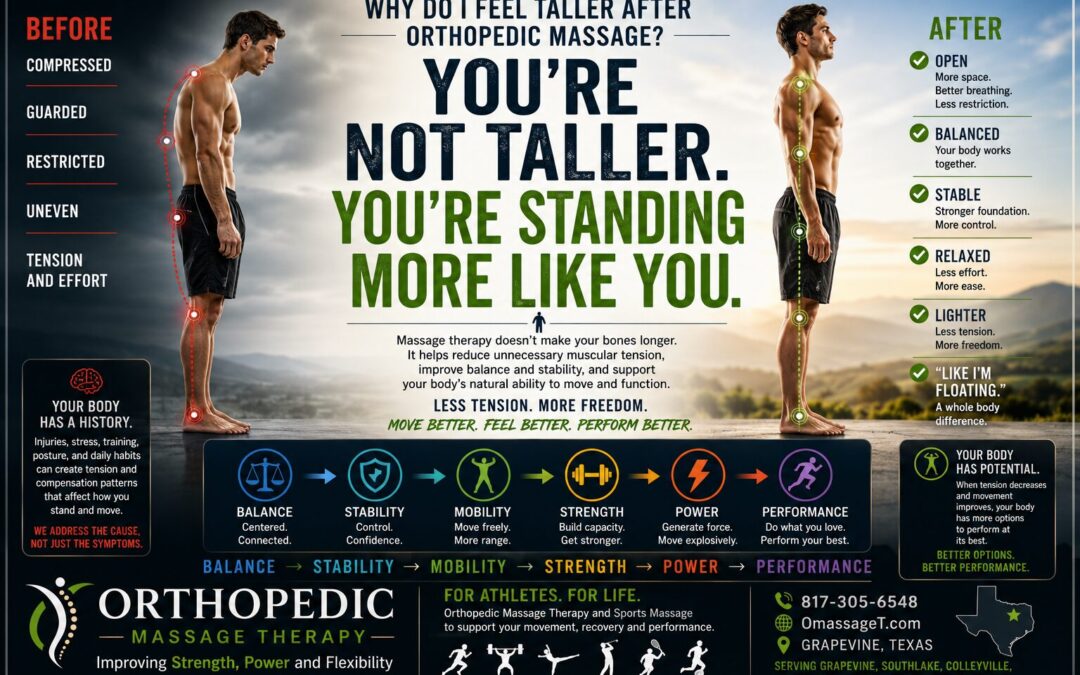
Clients sometimes tell me they feel taller, lighter, more open, or as if they are floating after a session.
I explain that the treatment did not make their bones longer. They may be experiencing less muscular guarding, easier breathing, improved freedom of movement, or a reduced sense of compression. In other words, they may feel closer to their natural height and movement—not physically taller.
That feeling can be especially noticeable when the hips, pelvis, diaphragm, ribs, upper back, and neck begin working together with less unnecessary tension.
A Pain-Free Approach to Alignment
Painful pressure can make a person brace, hold their breath, or tighten against treatment. That is why my work is designed to remain comfortable.
Each session includes communication, assessment, treatment, and reassessment. Clients wear shorts and a tank top so they can remain covered and comfortable while moving into different positions. Depending on their needs, treatment may be performed face-up, face-down, or side-lying with a body-support system and supportive positioning.
I listen to the client throughout the session. If something feels painful, unsafe, or uncomfortable, we stop and adjust.
My general progression is:
Support balance.
- Develop stability.
- Encourage comfortable mobility and flexibility.
- Support strength.
- Support power.
- Improve performance for everyday life or athletic activity.
Not every person needs every step during one appointment. Some people require more time, different positioning, or several appointments because every body and situation is different.
When Medical Evaluation Is Important
I am a licensed massage therapist, not a doctor. I respect my professional license and the work of physicians, physical therapists, chiropractors, athletic trainers, and other healthcare professionals.
Massage therapy does not replace medical evaluation. Sudden severe pain, significant trauma, unexplained swelling, progressive weakness, persistent numbness, chest pain, difficulty breathing, fever, loss of coordination, or changes in bowel or bladder control should be evaluated by an appropriate medical professional.
Comfortable Alignment Begins With Better Movement
Whole-body alignment is not about holding yourself rigidly or trying to look perfectly symmetrical. It is about giving your body options—the ability to breathe, change positions, move, and respond without unnecessary strain.
During orthopedic massage therapy, I consider the relationship between the painful area and the rest of the body. By working comfortably and reassessing movement, we can look for changes that support balance, mobility, flexibility, strength, and performance.
Orthopedic Massage Therapy
Steven Valenzuela, LMT
110 S Barton Street, Suite #6
Grapevine, Texas 76051
Text: 817-305-6548
Website: OmassageT.com
This article is for educational purposes and is not medical advice. Massage therapy does not diagnose, treat, or cure medical conditions.