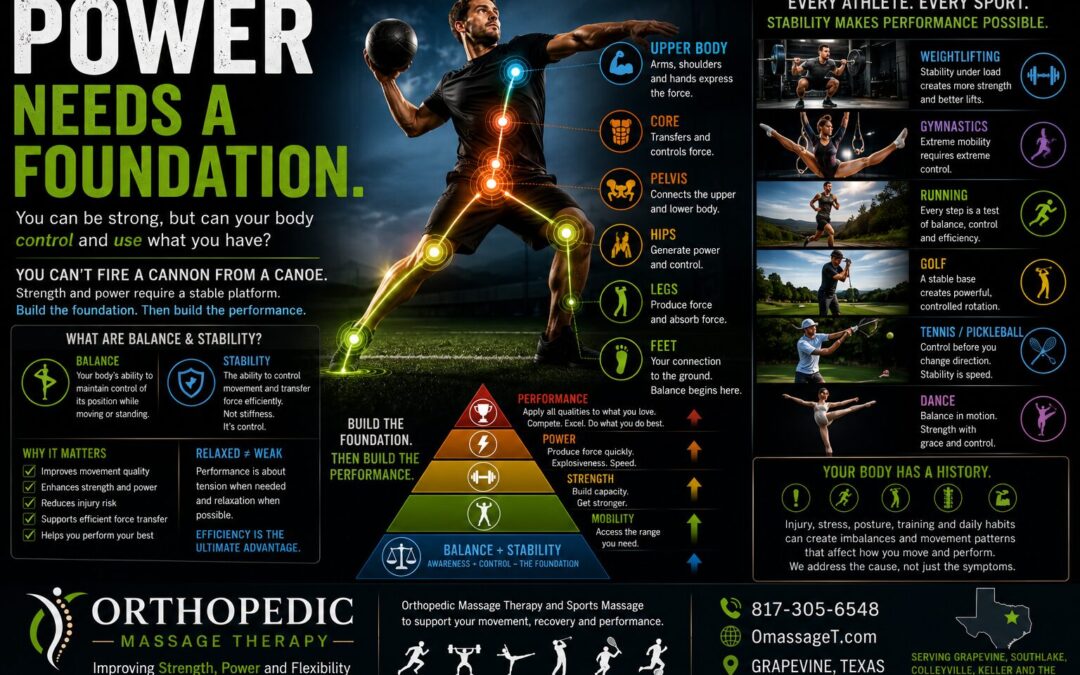
Your Core Is More Than Your Abdominal Muscles: Understanding Core Performance and Movement
When most people hear the word core, they immediately think about their abdominal muscles. But your core is much more than a six-pack or strong stomach muscles. Your core plays an important role in how your body moves, balances, stabilizes and transfers force from one part of the body to another.
At OmassageT.com in Grapevine, Texas, orthopedic massage therapy focuses on how different areas of the body work together. When someone experiences pain, stiffness or restricted movement, looking only at the location of the pain may not tell the entire story.
The relationship between the core, pelvis, hips, spine and surrounding muscles can be an important part of understanding movement and physical performance.
What Is the Core?
Your core is a group of muscles and structures that help support your trunk and stabilize your body. It includes more than the abdominal muscles. The muscles surrounding the abdomen, lower back, pelvis, hips and diaphragm all contribute to how your body creates and controls movement.
Your core helps provide a stable foundation while your arms and legs move.
Think about walking, running, lifting, throwing or changing direction. Your body needs coordination between the feet, legs, hips, pelvis, spine and upper body. The core helps connect these movements.
When the body is not moving efficiently, other areas may compensate.
The Connection Between Your Core and Pelvis
The pelvis is positioned between the upper and lower portions of the body. It has an important relationship with the lumbar spine, hips and core.
Changes in how someone sits, stands, walks or moves can affect how the muscles around the pelvis work.
For example, someone who spends many hours sitting may develop changes in muscle tension around the hips and pelvis. Previous injuries can also influence movement patterns. Even after an injury has healed, a person may continue moving differently because the body has adapted.
This does not necessarily mean that the pelvis is the cause of every pain problem. Instead, it is one area that may be worth considering when looking at the body’s overall movement.
Your Core Helps Transfer Movement
Your body does not operate as a collection of completely separate muscles.
When you move your leg, your trunk and pelvis are involved. When you reach with your arm, your spine and core contribute to the movement. When you run, force travels through your feet, legs, hips, pelvis and trunk.
This is one reason that a person can sometimes experience discomfort in one area while other parts of the body are also involved in how they move.
Orthopedic massage therapy can look at these relationships rather than focusing exclusively on the location where someone feels discomfort.
Core Performance Is About More Than Strength
A strong muscle is not automatically a muscle that is working efficiently.
Core performance also involves coordination, stability, mobility and the ability to work with the rest of the body.
Someone may have strong abdominal muscles and still experience limited mobility or difficulty maintaining balance. Likewise, someone may not be focused on building abdominal strength but may still need good core control for everyday activities.
The goal is not simply to make one muscle stronger. The goal is to help the body work together.
This is especially important for athletes.
Athletes Depend on Core Performance
Running, jumping, throwing, cutting and changing direction all require coordination between the core and the extremities.
For athletes, balance and stability can be important parts of performance and recovery.
High school football players, runners and other athletes place significant demands on their bodies. Previous injuries, repetitive movement and training volume can all influence how the body moves.
Orthopedic massage therapy can be part of a broader recovery approach that focuses on mobility and the relationship between different areas of the body.
The Hips and Core Work Together
The hips are closely connected to the pelvis and trunk.
When hip movement is restricted, the body may find other ways to complete a movement. Similarly, changes in movement around the pelvis can influence how the hips and lower back participate.
This is why looking at only the painful area may sometimes provide an incomplete picture.
For example, someone experiencing lower back discomfort may also have restrictions or changes in movement around the hips and pelvis. That does not mean the hips are always responsible for the back pain. It means the relationship between these areas can be worth examining.
Your Daily Habits Matter
Core performance is not determined only by what happens during exercise.
Your body spends hours every day sitting, standing, walking and sleeping.
A person who sits at a desk for long periods may notice changes in how their hips and spine feel. Someone who stands for long periods may develop different areas of tension. Sleeping positions can also influence how the body feels when you wake up.
These everyday positions add up.
Paying attention to how you sit, stand, breathe and move can be an important part of maintaining mobility and physical comfort.
Breathing Is Part of Movement
The diaphragm is one of the major muscles involved in breathing, and breathing is closely connected to how the trunk moves.
The body needs to coordinate breathing with movement and stabilization. This is one reason breathing can be an important consideration when looking at overall core performance.
Rather than constantly holding the abdominal muscles tight, efficient movement requires the body to adapt as you breathe, move and stabilize.
Learning to slow down and breathe can also help people become more aware of how their body feels.
Orthopedic Massage and Core Performance
Orthopedic massage therapy does not replace medical diagnosis or physical rehabilitation when those services are needed. Instead, massage can be used as part of a broader approach to supporting mobility, relaxation and movement.
At OmassageT.com, the goal is to work with the body rather than simply chase the location of discomfort.
The approach emphasizes balance, stability, strength, power and flexibility.
By considering relationships between the core, pelvis, hips, spine and surrounding soft tissues, an orthopedic massage session can focus on helping the body move more comfortably and efficiently.
Better Movement Starts With Understanding the Whole Body
Your core is much more than your abdominal muscles.
It is part of a larger system that connects your upper body and lower body and helps you balance, stabilize and move.
When you understand the relationship between the core, pelvis, hips and spine, you can begin to look at movement differently. Instead of thinking only about where something hurts, you can consider how your entire body is participating in the movement.
At OmassageT.com in Grapevine, Texas, orthopedic massage therapy focuses on improving movement through a whole-body approach.
Improving Strength, Power and Flexibility can begin with understanding how your body works together.
For more information or to schedule an appointment, contact OmassageT.com at 817-305-6548.
OmassageT.com
110 S Barton #6
Grapevine, Texas 76051
817-305-6548