The Connection Between Your Hips and Upper Back
When you have tension or discomfort in your upper back, it can be natural to focus on your shoulders, neck or upper spine. But your upper back does not work independently from the rest of your body.
Your hips, pelvis, lower back and upper back are all connected through the way your body moves.
This is especially important when looking at balance, stability, mobility and overall movement.
At OmassageT.com in Grapevine, Texas, orthopedic massage therapy takes a whole-body approach. Instead of looking only at where a person feels discomfort, the goal is to understand how different areas may be contributing to the way the body moves.
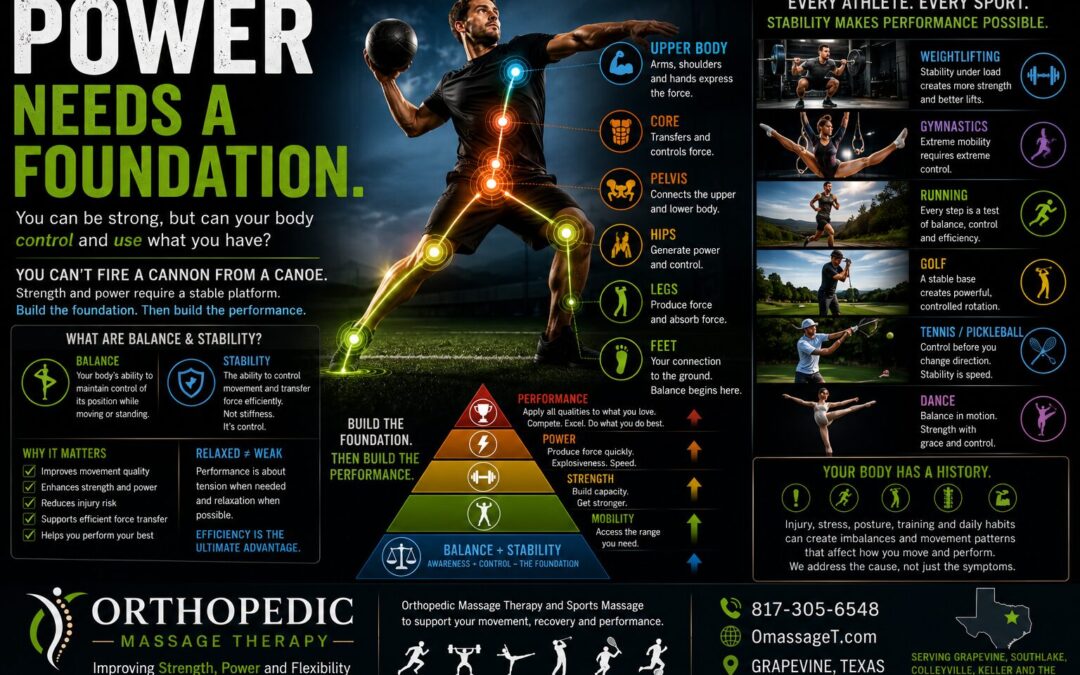
Your Body Works as a Movement Chain
Your feet connect to your legs. Your legs connect to your hips and pelvis. Your pelvis connects to your spine, and your spine continues upward into your upper back and neck.
Movement travels through this system.
When you walk, for example, your hips and pelvis move with each step while your spine and upper body respond to the movement below.
When you reach, lift, bend or rotate, multiple areas of the body work together.
This is why a restriction in one area can sometimes influence how another area moves.
It does not mean that hip tension is always the cause of upper back discomfort. There can be many causes of pain. But the relationship between the hips, pelvis and upper back can be worth considering when looking at overall movement.
How Your Hips Influence Your Movement
Your hips are designed to provide both mobility and stability.
They allow your legs to move while helping support the pelvis and trunk.
If hip movement becomes restricted, your body still has to accomplish everyday tasks. You may naturally find another way to complete the movement.
For example, instead of allowing movement to occur primarily through the hips, someone may rely more heavily on the lower or upper back.
Over time, repeated movement patterns can contribute to muscle tension or feelings of stiffness.
The Role of the Pelvis
The pelvis sits between the hips and spine, making it an important connection between the lower and upper body.
The position and movement of the pelvis influence how the spine responds during everyday activities.
Walking, standing, sitting and bending all require coordination between the pelvis and spine.
If someone has experienced a previous injury, spends long periods sitting or has developed a repetitive movement pattern, the muscles around the pelvis may work differently.
This can change how movement travels through the rest of the body.
Why the Upper Back Can Become Tight
Upper back tension can have many causes.
Long periods at a computer, repetitive activities, training, stress, sleeping positions and previous injuries can all influence how the upper back feels.
But movement from the lower body can also be part of the overall picture.
Your upper back helps position and move your shoulders, but it also responds to what is happening below.
When the pelvis and hips move, the spine has to accommodate that movement.
When the hips become restricted, other areas may compensate.
Sitting Can Connect the Hips and Upper Back
One of the most common examples is prolonged sitting.
When you sit for hours, your hips remain in a flexed position for an extended period.
At the same time, many people gradually move their head and shoulders forward while looking at a computer or phone.
This creates a pattern in which the hips, pelvis, spine, shoulders and neck are all participating in the same position.
Standing up occasionally, walking and changing positions throughout the day can help prevent the body from staying in one position for too long.
Movement matters.
Your Core Connects the Two
The core helps provide stability between the upper and lower body.
It includes more than the abdominal muscles. The muscles surrounding the trunk, pelvis, lower back and diaphragm all contribute to how your body stabilizes and moves.
When your hips move, your core helps control the trunk.
When your arms move, your core helps connect that movement to the rest of your body.
This is one reason core performance is about more than abdominal strength.
It is about how the body coordinates movement.
What Happens After an Old Injury?
Previous injuries can change movement patterns.
Imagine someone who injured a hip or leg years ago. Even after the original injury has healed, that person may have developed habits that protect the area.
They might shift their weight slightly when standing, walk differently or avoid certain movements.
Those changes can affect how the pelvis and spine move.
This does not mean an old injury is necessarily responsible for current pain. It simply means previous injuries can be valuable information when considering how someone moves today.
Athletes Need the Connection
Athletes constantly transfer force through the body.
Running, jumping, throwing, kicking and changing direction require coordinated movement between the lower body and upper body.
For example, a runner needs the hips and pelvis to work efficiently while the trunk remains controlled.
A football player needs to accelerate, stop, change direction and absorb forces.
A gymnast needs mobility and stability throughout the entire body.
The hips and upper back are not separate systems during these activities. They are part of the same movement chain.
Orthopedic Massage and Whole-Body Movement
Orthopedic massage therapy can focus on muscles and soft tissues that contribute to movement.
At OmassageT.com, the approach considers the relationships between areas such as the hips, pelvis, lower back, upper back and shoulders.
The objective is not simply to massage the place where someone feels discomfort.
Instead, the session can consider how the body is moving as a whole.
Working with areas of muscular restriction may help support mobility and relaxation, while a whole-body approach can provide a broader perspective on movement.
Balance and Stability Matter
Good movement requires a combination of mobility and stability.
The hips need enough mobility to move freely, while the pelvis and core need enough stability to control the trunk.
The upper back needs to move while also providing a foundation for shoulder movement.
When these areas coordinate effectively, movement can feel more natural.
This is one reason the focus at OmassageT.com includes:
Balance.
Stability.
Strength.
Power.
Flexibility.
These qualities work together.
Looking Beyond the Upper Back
If your upper back feels tight, the answer may not always be found by focusing exclusively on the upper back.
Your hips, pelvis, lower back and core all participate in movement that eventually reaches the upper body.
A whole-body perspective can help you think differently about mobility and discomfort.
It can also help athletes understand why recovery involves more than the muscles that were used during a particular workout.
Supporting Better Movement
Orthopedic massage therapy is not a substitute for medical evaluation when you have serious, persistent or unexplained pain. But massage can be part of a broader approach to supporting relaxation, mobility and physical performance.
At OmassageT.com in Grapevine, Texas, the focus is on helping people improve how their bodies move through a comfortable, pain-free orthopedic massage approach.
The connection between your hips and upper back is one example of how the body works together.
Improving Strength, Power and Flexibility starts with understanding that movement is connected.
OmassageT.com
110 S Barton #6
Grapevine, Texas 76051
817-305-6548