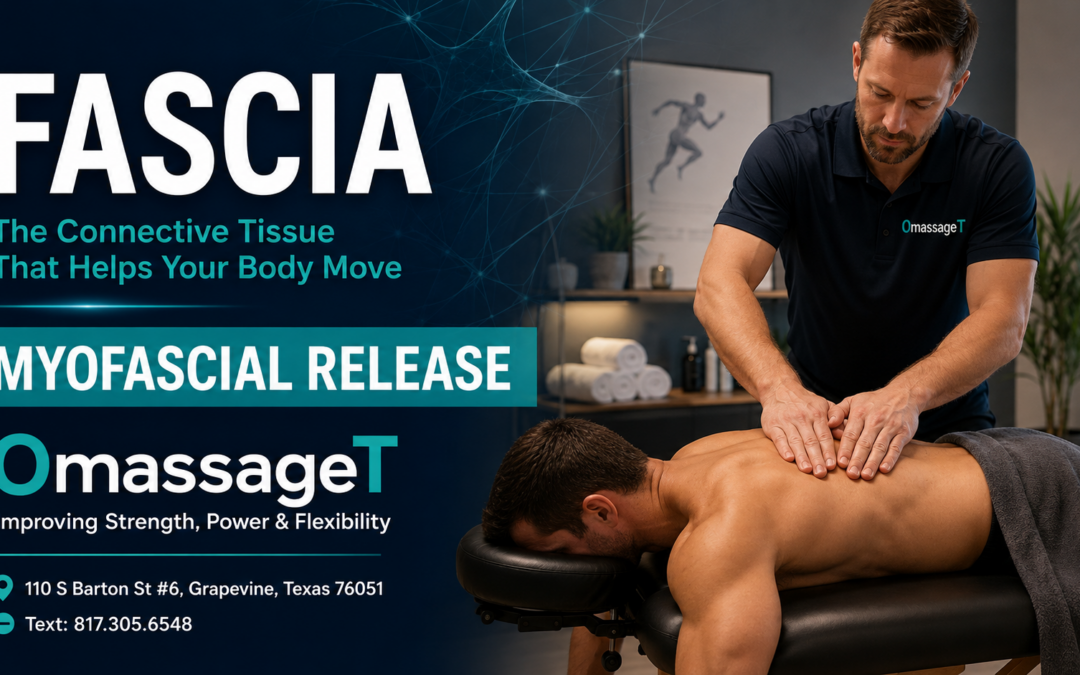
What Is Fascia and Why Does It Matter for Movement?
When people think about muscles, they usually picture the individual muscles that help them walk, lift, run or exercise. But muscles do not work alone.
Throughout the body is a network of connective tissue called fascia.
Fascia surrounds, separates and connects many structures throughout the body, including muscles and other tissues. It helps create a continuous framework through which the body can move.
When fascia and surrounding tissues are moving well, movement can feel easier. When areas become restricted, stiff or less mobile, a person may notice changes in how their body moves.
At OmassageT.com in Grapevine, Texas, fascia and myofascial work are part of a whole-body approach to orthopedic massage therapy.
What Is Fascia?
Fascia is connective tissue that forms a continuous network throughout the body.
Rather than thinking of fascia as one isolated structure, it can be helpful to think of it as a three-dimensional web that surrounds and connects different parts of the body.
It is found around muscles, between tissues and throughout many areas of the body.
This network helps provide structure while allowing different tissues to move in relation to one another.
Why Does Fascia Matter?
Your body needs tissues to move.
When you walk, your muscles contract and relax. Your joints move. Your skin moves. Your connective tissues respond to those movements.
Fascia is part of that process.
Healthy movement is not simply about whether one muscle is strong. It also involves how the different tissues of the body move together.
This is why mobility, flexibility and movement can be influenced by more than just muscle strength.
Fascia and Movement
Think about stretching your arm overhead.
Your shoulder moves.
Your upper back participates.
Your ribs move.
Your trunk adjusts.
Your muscles lengthen and contract.
The connective tissues surrounding these structures also respond.
Movement is a coordinated process.
This is one reason a restriction in one area may influence how the body moves elsewhere.
It does not mean that every painful area is caused by fascia. Pain can have many causes, and persistent or unexplained symptoms should be appropriately evaluated.
But fascia is an important part of understanding how the body’s tissues interact.
What Happens When Tissue Becomes Restricted?
People sometimes describe areas of their body as feeling tight, bound up, stiff or restricted.
There can be many reasons for these sensations.
Previous injuries, repetitive activity, prolonged sitting, athletic training and changes in movement can all influence how tissues feel and move.
When an area becomes restricted, the body may adapt.
Other muscles or areas may begin doing more work to complete a movement.
Over time, a person may notice changes in flexibility, balance or movement.
Previous Injuries and Fascia
An injury can change how a person moves.
Even after an injury has healed, someone may continue protecting the area or moving differently.
For example, a person with a previous leg injury may shift their weight while walking. Someone with a previous shoulder injury may avoid certain movements.
These adaptations can influence how surrounding tissues are used.
This is one reason a person’s history can be important when looking at movement.
Fascia and Athletes
Athletes place repeated demands on their bodies.
Running, jumping, throwing, lifting and changing direction all require coordinated movement.
A runner may repeatedly load the same areas.
A football player may sprint, stop and change direction.
A gymnast may repeatedly move through large ranges of motion.
Recovery involves more than resting a single muscle.
The body needs mobility, stability and coordination across many areas.
Fascia is part of that larger system.
Why Flexibility Is More Than Stretching
When people want to improve flexibility, stretching is often the first thing they consider.
Stretching can be useful, but flexibility is not simply about forcing a muscle to become longer.
Movement depends on joints, muscles, connective tissues, the nervous system and how the body coordinates movement.
This is why someone can stretch regularly and still feel restricted in certain movements.
There may be other factors involved.
What Is Myofascial Release?
Myofascial release refers to hands-on techniques intended to work with the muscles and surrounding fascial tissues.
The goal is generally to address areas of restriction and help support comfortable movement.
Different practitioners use different techniques and approaches.
At OmassageT.com, myofascial work is incorporated into a broader orthopedic massage approach that considers how different areas of the body work together.
The focus is on working with the body rather than forcing it.
Why Pain-Free Work Matters
Some people associate effective massage with intense pressure or pain.
That is not the approach at OmassageT.com.
The goal is to provide pain-free orthopedic massage therapy.
A comfortable environment allows the client to communicate throughout the session and helps create an experience centered around relaxation and body awareness.
The objective is not to “fight” the tissue.
It is to work with the body.
Fascia and the Whole Body
One of the most interesting aspects of fascia is that it helps us think about the body as an interconnected system.
Your feet are connected to your legs.
Your legs connect to your hips and pelvis.
Your pelvis connects to your spine.
Your spine connects to your rib cage, shoulders and neck.
Movement occurs across these relationships.
This is one reason orthopedic massage therapy can benefit from a whole-body perspective.
Fascia, Balance and Stability
Balance requires constant communication between different parts of the body.
Your feet sense the ground.
Your legs respond.
Your hips and pelvis adjust.
Your core stabilizes your trunk.
Your spine and upper body make small movements to maintain your position.
Fascia is part of the connective tissue system surrounding these structures.
When considering movement, it can therefore be useful to think beyond individual muscles.
How Orthopedic Massage Works With Movement
At OmassageT.com in Grapevine, Texas, orthopedic massage therapy focuses on balance, stability, strength, power and flexibility.
Fascia and myofascial work can be part of that approach.
Rather than focusing exclusively on where someone feels discomfort, the session can consider surrounding areas and how the body moves as a whole.
The goal is to support comfortable movement and help the client become more aware of their body.
Listen to Your Body
Your body gives you information through movement.
You may notice that one side feels tighter.
You may feel restricted when reaching overhead.
You may have difficulty rotating.
You may feel stiff after sitting.
You may notice that an old injury still seems to influence how you move.
These observations do not automatically identify the cause of a problem, but they can be useful information.
If you have significant, persistent or unexplained pain, an appropriate healthcare professional can help evaluate the underlying issue.
Improving Strength, Power and Flexibility
Fascia is only one part of a much larger system, but understanding it can change the way you think about movement.
Your muscles, connective tissues, joints and nervous system all contribute to how you move.
At OmassageT.com, the goal is to work with the body through a comfortable, pain-free orthopedic massage approach while focusing on Improving Strength, Power and Flexibility.
Better movement is not always about working harder.
Sometimes it begins with understanding how the different parts of your body are connected.
OmassageT.com
110 S Barton #6
Grapevine, Texas 76051
817-305-6548