How Tight Fascia Can Affect Mobility
Have you ever felt like a part of your body was tight, stiff, restricted or bound up?
You may stretch, move around or massage the area and still feel as though something is limiting your movement.
There can be many reasons for stiffness and restricted mobility, including muscle tension, joint limitations, previous injuries, repetitive activity and other factors. One part of the body that can also be involved is the fascia.
Fascia is connective tissue that surrounds and connects structures throughout the body. Because it forms a continuous network, changes in one area can influence how the body moves as a whole.
At OmassageT.com in Grapevine, Texas, orthopedic massage therapy includes myofascial work as part of a whole-body approach to movement.
What Does “Tight Fascia” Mean?
When people describe fascia as “tight,” they are usually describing an area that feels restricted or does not seem to move easily.
Fascia itself is not simply a piece of tissue that becomes tight like a rubber band.
The experience of restricted movement can involve multiple factors, including muscles, connective tissue, joints, the nervous system and movement habits.
That is why there is rarely one explanation for every person’s stiffness.
The important question is often:
Why does this area not move the way I want it to?
Why Can the Body Feel Bound Up?
People can develop a feeling of being “bound up” for many reasons.
For example, someone may experience changes in movement after:
-
A previous injury
-
Repetitive activity
-
Athletic training
-
Long periods of sitting
-
Surgery
-
Changes in daily activity
-
Protective movement patterns
The body adapts.
Sometimes those adaptations can remain long after the original event.
Previous Injuries Can Change Mobility
An injury does not always affect only the moment when it occurs.
After an injury, people may unconsciously protect the affected area.
They may change how they walk, sit, stand, lift or exercise.
That can cause other areas to participate differently.
For example, someone who has injured one leg may place more weight on the other side. Someone who has injured a shoulder may change how they reach or rotate.
Over time, these patterns can become familiar to the body.
This is one reason previous injuries are important information when considering mobility.
Why Stretching Does Not Always Solve the Problem
Stretching can be helpful for many people.
But flexibility is more complicated than simply making a muscle longer.
Your ability to move depends on your joints, muscles, connective tissues and nervous system, along with your coordination and movement habits.
If a person repeatedly stretches an area but still feels restricted, there may be other factors contributing to the limitation.
That does not mean stretching is ineffective.
It means stretching may be only one piece of the puzzle.
Fascia and Movement
Imagine reaching your arm overhead.
Your shoulder blade moves.
Your shoulder joint moves.
Your upper back participates.
Your ribs move.
Your trunk adjusts.
Multiple tissues respond to the movement.
The body is not a collection of isolated pieces.
Fascia forms part of the connective tissue network surrounding many of these structures.
This is one reason myofascial work can be incorporated into a broader approach to mobility.
Why Restricted Areas Can Affect Other Areas
When one area of the body does not move well, another area may compensate.
For example, if hip movement is restricted, the body may find another way to complete a movement.
If the upper back is stiff, the neck or shoulders may participate differently.
If one side of the body feels restricted, the other side may take on more of the movement.
This does not mean that one tight area automatically causes pain somewhere else.
Rather, it demonstrates how the body adapts.
Mobility Is More Than Flexibility
Flexibility and mobility are related, but they are not exactly the same.
Flexibility generally refers to the ability of tissues to lengthen.
Mobility is the ability to move a body part through a range of motion with control.
You can have good flexibility and still have difficulty controlling a movement.
Likewise, improving mobility may require more than stretching.
It may involve strength, stability, coordination and awareness.
Fascia and Athletes
Athletes repeatedly challenge their bodies.
Running, jumping, lifting, throwing and changing direction all require the body to move through repeated patterns.
Training can improve strength and performance, but recovery is also important.
When an athlete notices that one area feels unusually restricted, it can be useful to consider the entire movement pattern rather than focusing exclusively on the tight spot.
This is particularly relevant for runners and high school football players, where repetitive movement and previous injuries can influence how the body performs.
Why Myofascial Work Can Be Part of Orthopedic Massage
Myofascial work is one approach used by massage therapists to address areas of muscular and soft-tissue restriction.
At OmassageT.com, myofascial techniques are incorporated into a broader orthopedic massage approach.
The goal is not simply to press harder.
The goal is to work with the body’s tissues in a way that supports comfortable movement.
The client’s feedback is important throughout the process.
Pain-Free Does Not Mean Ineffective
There is a common idea that massage has to hurt to work.
That is not the philosophy at OmassageT.com.
The approach is centered around pain-free orthopedic massage therapy.
The body can be worked with without intentionally creating unnecessary pain.
Comfort also allows the client to relax and communicate about what they are feeling.
The goal is to help the body move more comfortably—not to prove how much pressure can be tolerated.
The Importance of the Whole Body
When working with restricted mobility, it can be tempting to focus only on the tightest area.
But the body is connected.
A restricted hip may influence how someone moves their pelvis.
The pelvis affects how the spine moves.
The spine affects how the shoulders and upper body move.
The feet and legs influence the entire movement chain.
Looking at the whole body can provide additional context.
What You May Notice After Working With Restricted Areas
People can experience different sensations after massage and myofascial work.
Some may notice that an area feels easier to move.
Others may feel more relaxed or notice improved awareness of how they are standing or moving.
Some people describe feeling more open or balanced.
These experiences are individual and are not a guarantee of a particular result.
The goal is to support comfortable movement and help the client understand their body.
Mobility, Balance and Stability
Mobility does not exist by itself.
Your body also needs stability.
For example, your hips need enough mobility to move while your pelvis and core provide control.
Your shoulders need mobility while your upper back and trunk provide stability.
Your ankles need to move while your legs maintain control.
This combination of mobility and stability is essential for everyday movement and athletic performance.
When Should You Seek Professional Evaluation?
Not every limitation in movement is a massage problem.
Persistent, severe or unexplained pain should be evaluated by an appropriate healthcare professional.
Likewise, sudden weakness, numbness, significant swelling or other concerning symptoms require appropriate medical attention.
Massage therapy can be part of a broader approach to movement and recovery, but it should not replace medical diagnosis or treatment when those are needed.
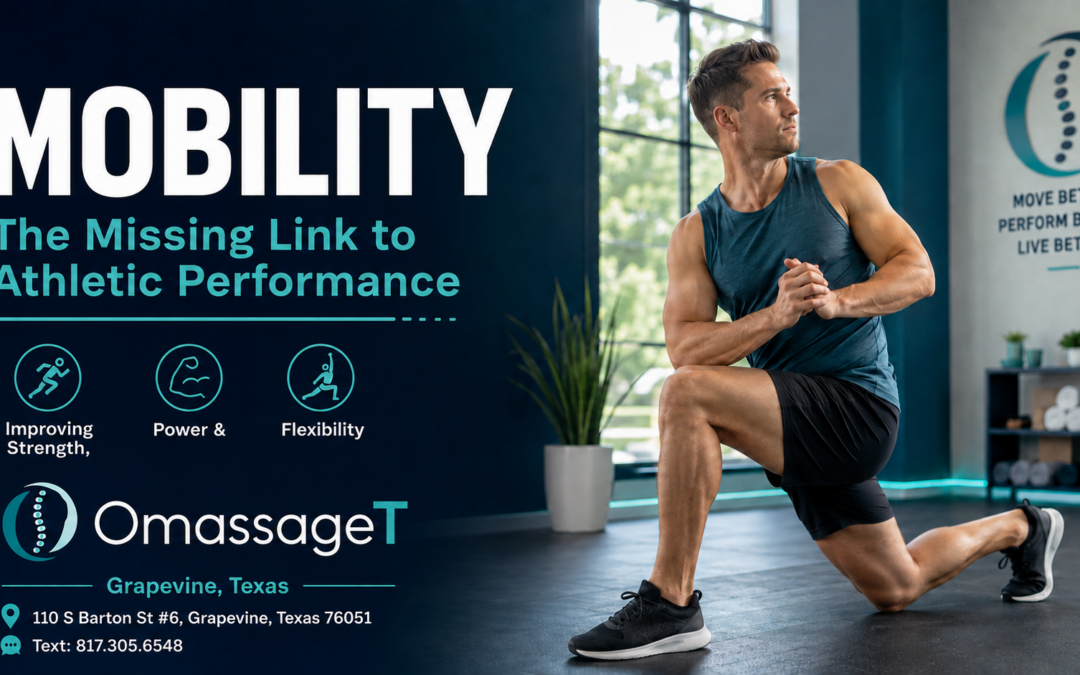
Improving Strength, Power and Flexibility
At OmassageT.com in Grapevine, Texas, orthopedic massage therapy focuses on the relationships between different areas of the body.
Fascia and myofascial work can be part of that approach.
The goal is to support balance, stability, strength, power and flexibility while helping people move more comfortably.
If your body feels tight or bound up, the answer may not simply be to stretch harder.
Sometimes the better starting point is to understand why your movement feels restricted and how the different parts of your body are working together.
OmassageT.com
110 S Barton #6
Grapevine, Texas 76051
817-305-6548