Myofascial Release: What It Is and How It May Help Movement
Have you ever felt like part of your body was stuck, restricted or “bound up”?
You may notice that one area does not move as easily as it used to. You may feel tight after an old injury, repetitive activity, long hours of sitting or athletic training.
There can be many reasons for restricted movement. Muscles, joints, connective tissues, movement habits and the nervous system can all play a role.
One approach that massage therapists use when working with soft-tissue restrictions is myofascial release.
At OmassageT.com in Grapevine, Texas, myofascial work is incorporated into a comfortable, pain-free orthopedic massage approach focused on helping the body move more freely.
What Does “Myofascial” Mean?
The word myofascial combines two ideas:
-
Myo refers to muscle.
-
Fascial refers to fascia, the connective tissue surrounding and connecting structures throughout the body.
Muscles and fascia work together as part of the body’s movement system.
When you move, your muscles contract and relax while surrounding tissues adapt to that movement.
This is one reason massage therapy may consider both muscles and the tissues around them.
What Is Myofascial Release?
Myofascial release describes hands-on techniques intended to work with areas of muscular and soft-tissue restriction.
Different massage therapists may use different methods.
Some techniques involve sustained pressure. Others involve movement, stretching or working through layers of soft tissue.
At OmassageT.com, myofascial work is not viewed as an isolated technique.
It is part of a larger orthopedic massage approach that considers how different parts of the body work together.
Why Can Areas Feel “Bound Up”?
People sometimes describe restricted areas as feeling tight, stuck or bound up.
This sensation can occur for many reasons.
A previous injury may have changed the way someone moves.
Repetitive activity may place repeated demands on certain tissues.
Long periods of sitting may keep the body in one position.
Athletic training can create substantial physical demands.
The body adapts to these situations.
Sometimes those adaptations can leave a person feeling less mobile than they would like.
Fascia Is Part of a Connected System
Fascia surrounds and connects structures throughout the body.
This helps explain why movement is not simply about one muscle operating independently.
Consider a simple movement such as reaching overhead.
Your hand moves.
Your arm moves.
Your shoulder blade participates.
Your shoulder joint moves.
Your upper back and ribs respond.
Your trunk stabilizes.
Many different tissues participate in that movement.
Myofascial work can therefore be considered as part of a whole-body approach rather than simply focusing on one muscle.
Myofascial Release and Mobility
Mobility is the ability to move a body part through a range of motion with control.
When movement feels restricted, people often try to stretch the area.
Stretching can be useful, but it is not always the only consideration.
Mobility can also involve joint movement, muscle function, connective tissue, coordination, strength and stability.
Myofascial work may be one component of a broader strategy for supporting comfortable movement.
Previous Injuries Matter
A previous injury can affect how someone moves long after the original event.
Imagine someone who injured their hip several years ago.
They may have started shifting their weight to the opposite side.
Or perhaps they changed how they walk.
Maybe they avoided certain movements because they were uncomfortable.
Those adaptations can become familiar.
When someone comes in for orthopedic massage, understanding their history can provide useful context for looking at current movement patterns.
Myofascial Work for Athletes
Athletes constantly challenge their bodies.
Runners repeatedly load their legs.
Football players accelerate, stop and change direction.
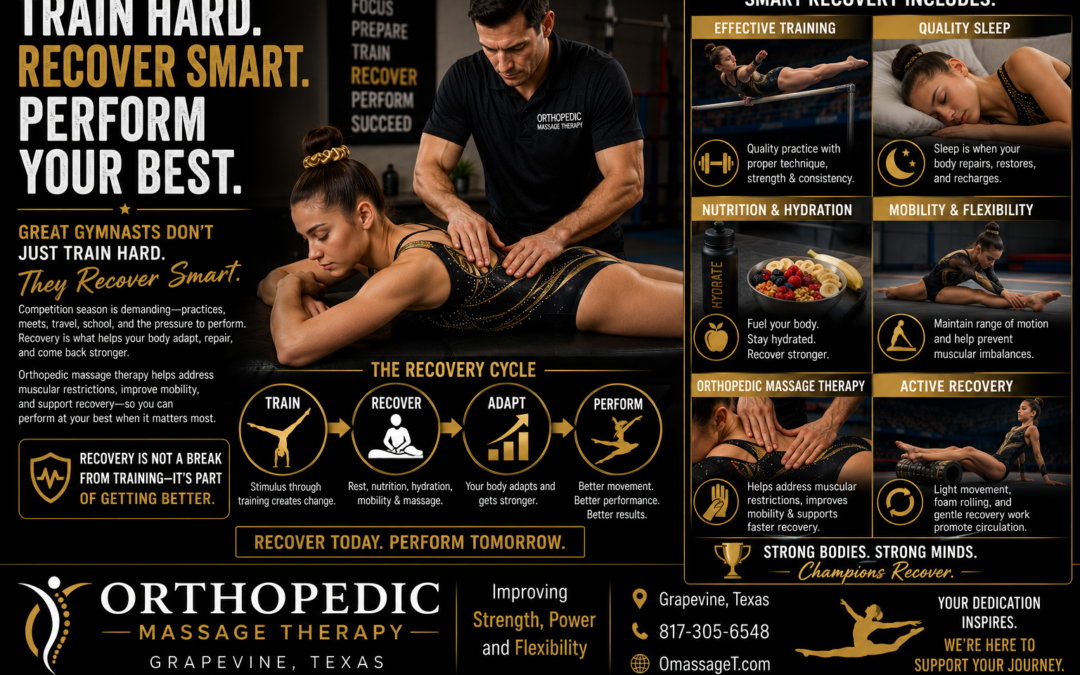
Gymnasts require strength, mobility and control.
Weightlifters repeatedly place demands on their muscles and connective tissues.
Recovery is therefore an important part of athletic performance.
Myofascial work may be incorporated into a recovery-focused massage session to address areas that feel restricted while supporting overall mobility.
The Importance of Balance and Stability
Improving flexibility is only one part of improving movement.
Your body also needs stability.
For example, the hips need mobility while the pelvis and core help stabilize the trunk.
The shoulders need mobility while the upper back and trunk help provide control.
The ankles need mobility while the legs maintain stability.
This is why the goal at OmassageT.com is not simply to make the body “loose.”
The focus includes:
Balance.
Stability.
Strength.
Power.
Flexibility.
These qualities work together.
Why Pain-Free Work Matters
Some people believe that deep massage has to hurt to be effective.
That is not the approach at OmassageT.com.
The goal is pain-free orthopedic massage therapy.
Instead of intentionally creating pain, the therapist works with the body and communicates with the client throughout the session.
Comfort can help the client relax and remain aware of how the body is responding.
The objective is to work with restricted areas without turning the session into a test of how much discomfort someone can tolerate.
What Does Myofascial Release Feel Like?
Every person responds differently.
Some people may experience a sense of pressure or stretching.
Others may notice that an area gradually feels more relaxed.
Some people may notice a difference in how they move immediately after a session.
Others may notice changes over time as they continue moving and participating in their normal activities.
There is no single sensation that everyone should expect.
The experience depends on the individual and the areas being addressed.
Myofascial Release Is Not a Cure-All
It is important to be realistic about what massage therapy can and cannot do.
Not every pain problem is caused by fascia.
Not every restricted movement can be resolved through massage.
Some conditions require medical evaluation, physical therapy, medication, imaging or other forms of treatment.
Massage therapy can be part of a broader approach to relaxation, mobility and recovery, but it should not replace appropriate medical care.
Looking at the Whole Body
One of the biggest benefits of thinking about myofascial work is that it encourages a broader view of movement.
Instead of asking only:
“Where does it hurt?”
You can also ask:
“How is my body moving?”
Are you shifting your weight?
Is one side moving differently?
Are your hips moving comfortably?
Can you rotate your upper body?
Does an old injury still influence your movement?
These questions can provide useful information.
Orthopedic Massage and Myofascial Work
At OmassageT.com in Grapevine, Texas, orthopedic massage therapy combines a whole-body perspective with hands-on work.
Myofascial techniques may be used when appropriate to address areas of muscular and soft-tissue restriction.
The goal is to help support comfortable movement while considering the relationships between the body’s different structures.
This can be especially relevant for people dealing with stiffness, previous injuries or the physical demands of sports and everyday activity.
Improving Strength, Power and Flexibility
Myofascial release is not simply about making a tight muscle feel better.
It can be part of a larger conversation about movement.
Your muscles, fascia, joints, core, pelvis and nervous system all contribute to how you move.
At OmassageT.com, the goal is to help clients better understand those connections while supporting balance, stability, strength, power and flexibility through a comfortable orthopedic massage approach.
If your body feels restricted or “bound up,” you do not necessarily need to push harder.
Sometimes the first step is understanding what may be limiting your movement and working with your body rather than against it.
OmassageT.com
110 S Barton #6
Grapevine, Texas 76051
817-305-6548