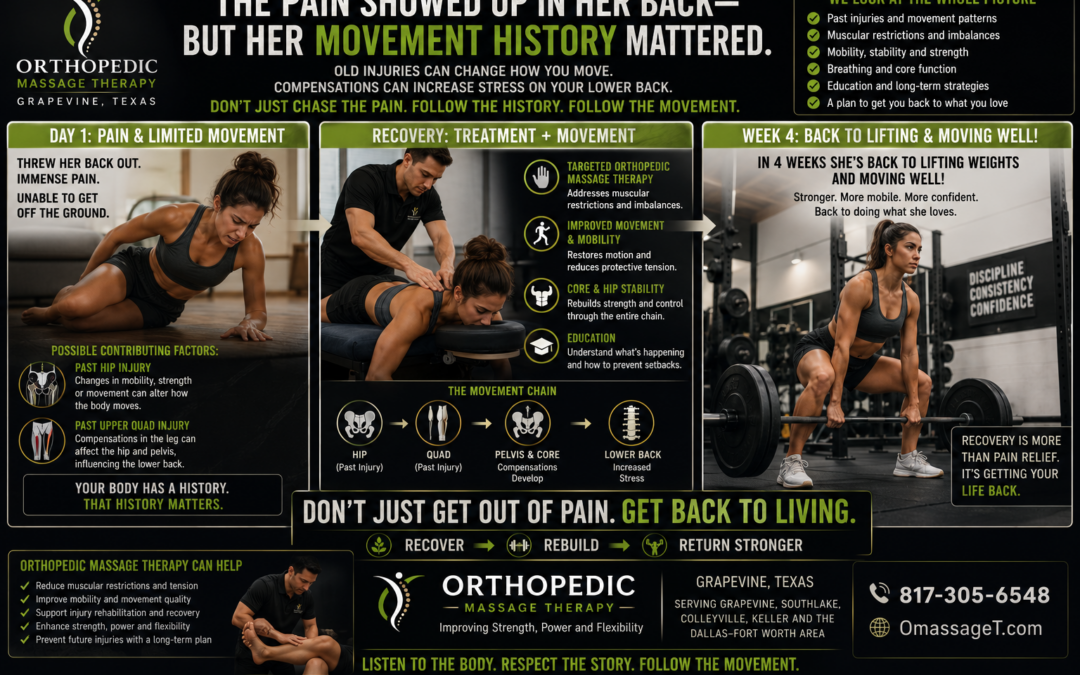
How Your Body Compensates After an Injury: Understanding Movement Patterns
When you injure your body, you may naturally begin moving differently.
You might put less weight on one leg, avoid turning in a certain direction, change the way you sit, or use another part of your body to accomplish a movement that used to be easy.
These changes can happen without you even realizing it.
The body is constantly trying to adapt. When something hurts or feels restricted, you may instinctively find another way to move.
This is often called compensation.
Compensation can be helpful during the early stages of an injury because it may allow you to continue performing necessary movements while protecting an uncomfortable area. However, if a changed movement pattern continues long after the original injury has improved, it may contribute to new areas of tension, restriction, or imbalance.
This is one reason injury rehabilitation involves more than simply waiting for pain to disappear.
What Is Compensation?
Compensation occurs when the body changes how it performs a movement because something is painful, weak, restricted, unstable, or difficult to control.
For example, imagine someone with an injured ankle.
They may temporarily avoid putting their full weight on that foot. Their knee, hip, pelvis, and even upper body may adjust to help them walk.
As the ankle improves, they may continue walking with the altered pattern simply because their body has become accustomed to it.
The person may eventually notice discomfort somewhere else.
That does not necessarily mean the original ankle injury caused the new discomfort. There can be many reasons for pain.
But the movement history can provide valuable information.
The Body Does Not Move One Joint at a Time
Movement involves relationships between many areas of the body.
When you walk, for example, your feet, ankles, knees, hips, pelvis, spine, rib cage, and arms all participate.
When you reach overhead, your shoulder is not working completely by itself. Your upper back, ribs, spine, core, pelvis, and lower body contribute to how that movement occurs.
This is why an orthopedic massage approach can consider the entire movement pattern rather than focusing exclusively on the location where someone feels discomfort.
A client may say, “My shoulder hurts.”
The shoulder certainly deserves attention.
But it may also be useful to consider what is happening with the upper back, rib cage, pelvis, core, and other areas involved in movement.
The purpose is not to assume that another body part is responsible for the pain.
It is to look at the bigger picture.
Your Core and Pelvis Can Play an Important Role
The core is more than the abdominal muscles.
Your core and pelvis are involved in helping stabilize the body while you move.
If your movement changes after an injury, your core and pelvis may participate differently than they did before.
For example, someone recovering from a leg injury may shift their weight to one side. Someone with back discomfort may move more cautiously or avoid certain ranges of motion.
Over time, these changes can influence how the hips, lower back, thoracic spine, and shoulders participate in movement.
This is one reason I pay attention to core performance, balance, and stability when working with clients.
A strong movement foundation is not simply about having strong abdominal muscles.
It is about how the body coordinates movement and stability.
Compensation Can Happen After Old Injuries
Not every injury is recent.
Sometimes a client will tell me about an injury that happened years ago.
They may say:
“I haven’t had a problem with it for a long time.”
That can be true.
However, the body may still have adapted to the injury.
Perhaps the person learned to stand differently. Maybe they changed the way they walked, ran, exercised, or slept. They may have avoided certain movements for so long that the new pattern became normal.
Again, this does not mean the old injury is definitely causing a current problem.
But it can be an important part of the person’s history.
When evaluating movement, understanding previous injuries can help provide context for what the body is doing today.
Why One Area May Feel Tight While Another Area Hurts
One of the interesting things about compensation is that the area that feels tight is not necessarily the same area where someone experiences discomfort.
For example, a person might experience shoulder discomfort while also noticing significant restriction through the upper back.
Another person may have knee discomfort while experiencing limited mobility around the hip or ankle.
Someone with lower-back discomfort may also have restrictions involving the hips or pelvis.
There are many possible explanations for these patterns, so it is important not to assume a single cause.
But looking at the relationship between different areas can provide useful information.
This whole-body perspective is especially relevant when the goal is to improve movement, mobility, balance, and stability.
Fascia May Be Part of the Movement Picture
Another consideration is fascia.
Fascia is connective tissue that surrounds and connects many structures throughout the body.
After an injury, changes in activity and movement can affect how different tissues are loaded and how freely they move.
Some people describe restricted areas as feeling “bound,” “stuck,” or as though something is pulling.
These sensations can have different causes.
In my work, myofascial release may be used as part of a hands-on approach to areas that feel restricted.
The objective is not simply to push harder.
It is to work with the tissues while allowing the client to remain comfortable and relaxed.
Pain-Free Orthopedic Massage
I use a pain-free orthopedic massage approach.
There is sometimes a misconception that therapeutic massage has to hurt in order to be effective.
I do not approach treatment that way.
When the body is already protecting an area, adding unnecessary discomfort may not be the experience I want for the client.
Instead, I focus on comfortable positioning, communication, and working with the body in a way that supports relaxation.
This allows me to work with different areas while paying attention to how the client responds.
Every person is different, and every injury history is different.
Balance and Stability Matter as Much as Flexibility
When people think about improving movement, they often think about stretching.
Flexibility is important, but it is only one part of movement.
You also need stability.
You need balance.
You need enough strength to control your movement.
And depending on your activities, you may need power as well.
For athletes, this becomes especially important.
An athlete may have excellent flexibility but still experience difficulty controlling a movement. Another athlete may be very strong but have restrictions that affect mobility.
The goal is not simply to make one quality better.
It is to understand how these qualities work together.
Strength + power + flexibility + balance + stability = better movement potential.
Compensation and Athletic Performance
Athletes often become very good at working around limitations.
They may continue training despite soreness or a previous injury. They may modify their technique without realizing it.
Over time, a small movement change can become part of their normal pattern.
This is particularly important for athletes involved in repetitive activities such as running, football, gymnastics, or other sports.
A previous injury does not automatically mean an athlete is at risk for another injury.
However, understanding movement changes can be valuable when working toward recovery and performance.
Orthopedic massage therapy can be one component of an athlete’s broader recovery strategy, alongside appropriate medical care, strength training, mobility work, conditioning, and sport-specific training.
What Happens When You Stop Compensating?
The goal is not to force your body back into a particular position.
Instead, the goal is to help you become more aware of how you move and identify areas that may be restricting comfortable movement.
Sometimes clients notice that after a session they feel:
-
More balanced
-
More open
-
More relaxed
-
Less restricted
-
More stable
-
More comfortable moving
-
As though they are standing taller
Some people even describe feeling as though they are floating.
When someone says they feel taller, I explain that they have not actually grown taller.
They may simply be experiencing their natural posture and movement with less perceived restriction.
That can create a very different sensation.
Your Body May Have Learned a New Movement Pattern
One of the most important things to remember is that compensation is not necessarily a failure of the body.
It is often an adaptation.
Your body is trying to accomplish a task.
If something hurts or does not move normally, you find another way.
The challenge can come when that adaptation continues after the original problem has improved.
That is when it may be useful to look at the overall movement pattern.
Where are you putting your weight?
How are your hips moving?
How stable do you feel?
Can you move comfortably through both sides?
Does your upper body move naturally with your lower body?
Are you breathing comfortably while you move?
These questions can reveal information that simply asking “Where does it hurt?” may not.
Looking Beyond the Location of Pain
Pain is important information, but the location of pain is not always the complete story.
Your movement history, previous injuries, daily activities, posture, training, strength, flexibility, balance, and stability can all be relevant pieces of the bigger picture.
This is why my approach to orthopedic massage therapy focuses on the body as a connected system.
I work with clients to address areas of restriction and support more comfortable movement while considering the relationship between the core, pelvis, hips, spine, shoulders, fascia, and other areas involved in movement.
The goal is not to diagnose an injury through massage.
I am not a doctor, and massage therapy does not replace appropriate medical evaluation or treatment.
If you have severe, persistent, unexplained, or worsening pain, or if you suspect you have a significant injury, seek evaluation from an appropriate healthcare professional.
Injury Rehabilitation and Better Movement
Recovering from an injury is not always just about getting back to the point where something no longer hurts.
It can also be about understanding how your body moves afterward.
If you developed a new movement pattern while protecting an injury, becoming aware of that pattern may be an important part of returning to comfortable movement.
That is where injury rehabilitation, orthopedic massage therapy, myofascial work, and movement awareness can fit into a larger recovery process.
At OmassageT.com, my focus is on helping clients improve how their bodies move through a pain-free orthopedic massage approach.
The emphasis is on the whole body and on the qualities that support movement:
Balance. Stability. Strength. Power. Flexibility. Mobility.
When these elements work together, you may experience movement in a completely different way.
Orthopedic Massage Therapy in Grapevine, Texas
OmassageT.com
110 S Barton #6
Grapevine, Texas 76051
817-305-6548
Improving Strength, Power and Flexibility
Pain Relief by Improving/Repairing Core Performance