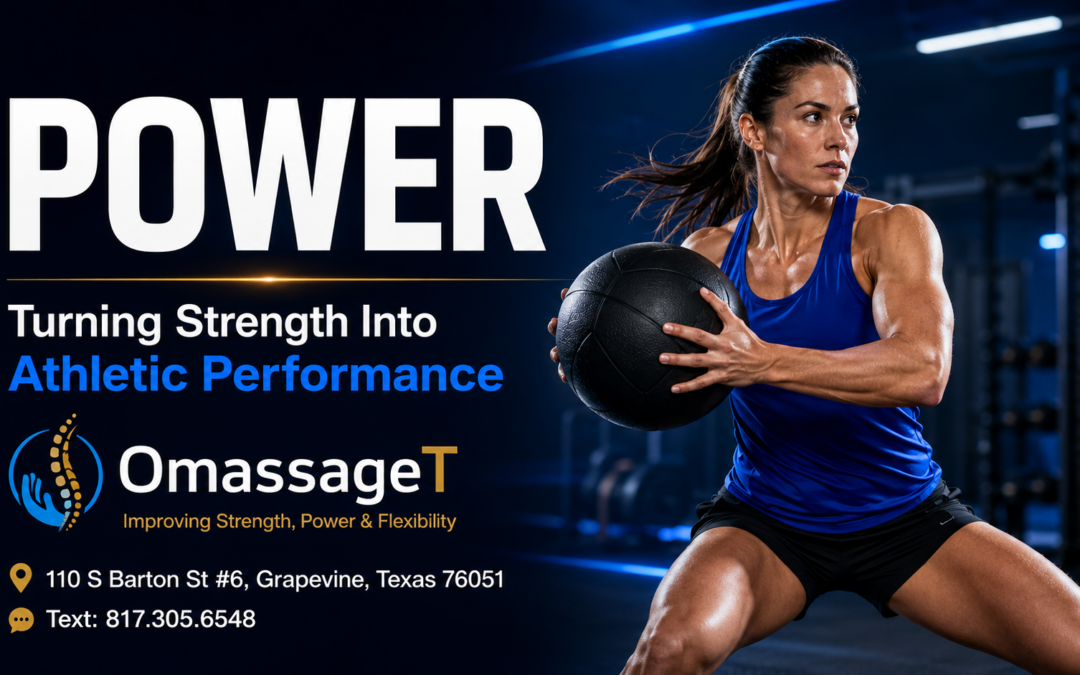
How Core Performance Can Affect Strength, Power and Flexibility
When people hear the word core, they often think about abdominal muscles.
But your core is much more than your abs.
Your core is involved in helping your body stabilize, transfer force, control movement and maintain balance while you move.
That makes core performance important for much more than getting stronger abdominal muscles.
Your core works with your pelvis, hips, spine, diaphragm and surrounding muscles to help create a stable foundation for movement.
At OmassageT.com in Grapevine, Texas, this relationship is an important part of an orthopedic massage approach focused on Improving Strength, Power and Flexibility.
What Is Core Performance?
Core performance is about how effectively your body can use the muscles and structures around your trunk to support movement.
It is not simply about how many sit-ups you can do.
Think about standing, walking, running, lifting or reaching.
Your body needs to control the relationship between your upper and lower body during each movement.
Your core helps provide that connection.
A well-coordinated core allows the body to stabilize when needed while still allowing movement where movement is necessary.
Your Core Connects the Upper and Lower Body
Your pelvis is located between your legs and your spine.
Your spine connects your pelvis to your upper body.
Your rib cage and shoulders continue that connection upward.
The core works throughout this system.
When you walk, your legs generate movement while your trunk remains controlled.
When you run, your body repeatedly transfers forces between your legs and upper body.
When you lift something, your core helps stabilize your trunk while your arms and legs do the work.
This is why core performance can influence the way the entire body moves.
Strength Is Only One Part of the Equation
Having strong muscles is valuable.
But strength by itself does not guarantee good movement.
Your body also needs:
- Balance
- Stability
- Mobility
- Coordination
- Flexibility
- Control
- Power
For example, someone may have strong legs but limited hip mobility.
Another person may be flexible but have difficulty maintaining stability during movement.
Another person may have good strength and flexibility but struggle to transfer force efficiently.
Core performance is about how these qualities work together.
The Difference Between Strength and Power
Strength and power are related, but they are not the same.
Strength is your ability to produce force.
Power involves producing force quickly.
Athletes often need both.
A football player accelerating off the line needs to produce force quickly.
A runner pushing into a sprint needs power.
A person getting up from a chair needs strength and coordination.
Your core contributes to the ability to stabilize and transfer forces during these movements.
Flexibility Needs Stability
Flexibility is another important part of movement.
But having flexibility without control is not necessarily enough.
Imagine being able to move your hip through a large range of motion.
Your body still needs to control that movement.
The same is true for your shoulders, spine and ankles.
This is why I often think about mobility and stability together.
You need enough movement to perform an activity, but you also need enough control to use that movement effectively.
Your Pelvis Is Part of Core Performance
The pelvis plays an important role in the relationship between your lower and upper body.
Your legs connect to the pelvis.
Your pelvis connects to the spine.
Your core muscles help stabilize the area.
When you walk, run, sit, stand or lift, your pelvis participates.
If your movement pattern changes after an injury or because of prolonged sitting, the way your pelvis participates may change as well.
This is one reason the pelvis is an important consideration when looking at whole-body movement.
The Diaphragm Is Part of the Core System
Breathing is another important part of core function.
The diaphragm is the primary muscle of respiration.
It moves with breathing and works in relationship with structures around the trunk.
Breathing is not separate from movement.
You breathe while walking.
You breathe while exercising.
You breathe while lifting.
You breathe while stretching.
You even change your breathing when you become tense or relaxed.
Learning to breathe comfortably while moving can help you become more aware of your body.
Core Performance and Balance
Balance requires constant adjustments.
Your feet communicate with the ground.
Your ankles respond.
Your knees and hips adjust.
Your pelvis moves.
Your core helps control your trunk.
Your upper body makes additional adjustments.
This happens continuously, often without conscious thought.
A strong core is not simply one that can resist movement.
A well-coordinated core also needs to allow appropriate movement.
That is an important distinction.
Core Performance After an Injury
Injury can change the way your core functions.
If you hurt your leg, hip or back, you may move differently to protect the area.
You may shift your weight.
You may rotate differently.
You may avoid certain movements.
Your core may then stabilize your body differently than it did before.
Even after the original injury improves, the movement pattern may remain.
This is one reason injury history can be important when looking at current movement.
Core Performance and Athletes
Athletes place significant demands on their core.
Runners need their trunk to remain controlled while their legs repeatedly produce force.
Football players need to accelerate, stop, change direction and absorb contact.
Gymnasts need exceptional control while moving through large ranges of motion.
Every sport has its own demands, but the connection between the trunk and the rest of the body remains important.
Core performance can therefore be part of athletic recovery and performance training.
What Happens When the Body Loses Balance?
Balance is not about making every part of the body perfectly symmetrical.
Human bodies are naturally asymmetrical.
Instead, balance involves the ability to control movement and distribute forces appropriately.
You may notice that one side feels tighter.
One leg may feel stronger.
You may naturally favor one side when standing.
These observations can provide useful information about your movement.
They do not automatically identify a problem.
But they can be worth paying attention to.
Orthopedic Massage and Core Performance
Orthopedic massage therapy does not replace strength training or physical therapy.
However, massage can be one component of a broader approach to movement and recovery.
At OmassageT.com, I look at relationships between areas such as the core, pelvis, hips, lower back, upper back and shoulders.
Myofascial work may be used when appropriate to address areas that feel restricted.
The goal is to help the body move comfortably rather than forcing movement.
Why Pain-Free Work Matters
My approach is based on pain-free orthopedic massage.
Some people believe that therapeutic massage has to hurt to produce results.
I don’t believe the session needs to become a test of how much discomfort someone can tolerate.
The client should be able to communicate throughout the session.
Comfort and relaxation are important parts of the experience.
The goal is to work with the body rather than fight against it.
Strength, Power and Flexibility Work Together
Think about an athlete sprinting.
They need strength to produce force.
They need power to produce that force quickly.
They need flexibility and mobility to move efficiently.
They need stability to control the movement.
They need balance to maintain body position.
They need coordination to put everything together.
The same basic principles apply to everyday movement, although the demands may be much lower.
This is why improving one quality should not always be considered separately from the others.
Improving Core Performance
Improving core performance does not necessarily mean doing hundreds of abdominal exercises.
It can mean becoming more aware of how your trunk, pelvis and hips work together.
It can mean improving mobility where movement is restricted.
It can mean developing strength and stability.
It can mean learning to control movement.
It can mean addressing previous movement patterns that developed after an injury.
And it can mean allowing your body to relax enough to move comfortably.
Looking Beyond the Pain
One of the central ideas behind my orthopedic massage approach is to look beyond the place where someone feels discomfort.
If someone has back pain, I may also consider the relationship between the back, pelvis and hips.
If someone has shoulder discomfort, the upper back, rib cage and core may also be relevant to movement.
This does not mean that the painful area should be ignored.
It means that the body should be considered as a connected system.
Pain Relief by Improving Core Performance
The phrase “Pain Relief by Improving/Repairing Core Performance” represents an important part of the philosophy behind OmassageT.com.
The idea is not that every pain problem comes from the core.
It doesn’t.
Pain can have many causes, and some conditions require medical evaluation.
Instead, the concept is that improving how the body moves and stabilizes itself can be an important part of addressing certain movement-related problems.
Looking beyond symptoms can sometimes provide a broader understanding of what the body is doing.
Improving Strength, Power and Flexibility
At OmassageT.com in Grapevine, Texas, the focus is on helping people move comfortably while developing greater awareness of how their bodies work.
The core is not just your abdominal muscles.
It is part of a larger movement system involving your pelvis, hips, spine, diaphragm, balance, stability, strength, power and flexibility.
When these systems work together, movement can become more coordinated and efficient.
That is the foundation of the OmassageT.com philosophy:
Improving Strength, Power and Flexibility.
OmassageT.com
110 S Barton #6
Grapevine, Texas 76051
817-305-6548
Pain Relief by Improving/Repairing Core Performance