From Injury Recovery to Performance: How Your Body Can Keep Moving Forward
An injury can change the way an athlete thinks about movement.
Before an injury, an athlete may take running, jumping, lifting and changing direction for granted.
After an injury, even a familiar movement can suddenly require more attention.
Recovery may involve rest, rehabilitation, gradual return to activity and learning how to trust the body again.
But recovery does not necessarily have to end when the original pain improves.
For athletes, there can be another step:
Moving from recovery toward performance.
This does not mean rushing back to competition.
It means gradually rebuilding the qualities that allow the body to move effectively.
Recovery Is a Process
Injury recovery is rarely as simple as waiting until something stops hurting.
Depending on the injury, recovery may involve several stages.
An athlete may first need to protect the injured area.
Then movement may gradually return.
Strength may be rebuilt.
Balance and stability may be challenged again.
Sport-specific movements may eventually be introduced.
The appropriate process depends on the injury and should be guided by qualified healthcare professionals when necessary.
Pain Improving Does Not Always Mean Everything Is Back to Normal
Pain is important information, but it is only one part of the picture.
An athlete may feel better while still rebuilding strength or movement control.
They may still have differences between the injured and uninjured sides.
They may feel hesitant during certain movements.
They may have lost conditioning while recovering.
That is why returning to sport can require more than simply asking:
“Does it hurt?”
Other questions can matter too:
Can I move comfortably?
Can I control the movement?
Have I regained appropriate strength?
Can I balance and stabilize?
Can I perform the movements my sport requires?
The Body Can Adapt After an Injury
When something hurts, people naturally protect it.
An athlete may put less weight on one leg.
They may change their stride.
They may avoid rotating.
They may use another part of the body more.
These adaptations can be useful during the early stages of recovery.
But as the athlete returns to activity, movement may need to be reassessed.
An old movement pattern can sometimes continue even after the original injury has improved.
An Old Injury Can Still Influence Movement
This is something I frequently consider when working with athletes.
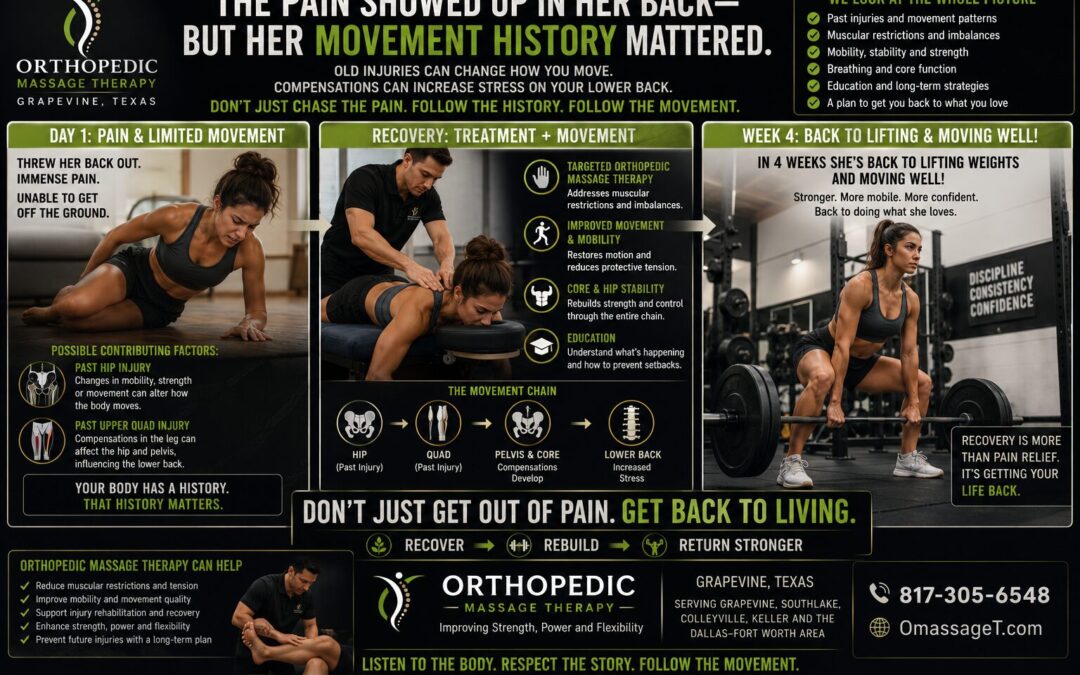
A previous injury can become part of an athlete’s movement history.
For example, an athlete who previously injured an ankle may have changed how they run.
Someone who injured a hip may have changed how they load one side of the body.
Someone who had a shoulder injury may move differently during overhead activity.
That does not mean the old injury is necessarily causing a current problem.
It means the history can provide useful context.
Balance After Injury
Balance can change after an injury.
This can be especially noticeable with injuries involving the lower extremities.
An athlete may have spent weeks or months avoiding certain movements.
Once they return to activity, they may need to rebuild confidence and control.
Balance training and rehabilitation can help address these needs when prescribed appropriately.
Stability After Injury
Stability is also important during the return to sport.
An athlete needs to control their body while forces are applied.
Running, jumping, landing and changing direction all require stability.
Returning to sport involves gradually restoring the ability to control these movements.
This is one reason rehabilitation programs often include progressive strength and movement exercises.
Mobility After Injury
Injury and recovery can sometimes affect mobility.
An athlete may become less comfortable moving a joint through certain ranges.
They may develop stiffness after periods of reduced activity.
Appropriate mobility work can be part of rehabilitation when recommended by the athlete’s healthcare team.
Massage may also be used as a complementary approach when appropriate.
The goal is comfortable movement—not forcing a joint beyond its appropriate range.
Strength Must Be Rebuilt
An athlete may lose strength during a period of reduced activity.
That strength needs to be rebuilt gradually.
The process depends on the injury, the athlete and the sport.
Strength training should be appropriately progressed rather than rushed.
An athlete returning to competition needs enough strength to handle the demands of their sport.
Power Comes Later in the Process
Power is different from basic strength.
It involves producing force quickly.
Athletes need power for sprinting, jumping, throwing and explosive changes of direction.
After an injury, an athlete may first need to rebuild basic movement and strength before progressing toward higher-speed or explosive activities.
The progression should be appropriate for the athlete and their rehabilitation plan.
Flexibility Is Part of Recovery
Flexibility can also be affected by injury, inactivity or protective movement patterns.
But more flexibility is not automatically better.
An athlete needs an appropriate range of motion for their sport and the ability to control that range.
That is why flexibility should be considered together with strength and stability.
The Core and Pelvis During Recovery
The core and pelvis play important roles in whole-body movement.
The pelvis connects the legs with the spine.
The core helps stabilize the trunk.
After an injury, an athlete may change how the pelvis and trunk participate in movement.
As the athlete returns to activity, rebuilding control through the core and pelvis can be important.
This is one reason I use the phrase:
Pain Relief by Improving/Repairing Core Performance.
It is not a claim that every injury comes from the core.
It reflects the importance of looking at the center of the body as part of the larger movement system.
The Role of Fascia
Fascia is connective tissue that surrounds and connects many structures throughout the body.
After an injury or period of reduced activity, an athlete may describe certain areas as feeling tight, stiff or restricted.
Myofascial techniques may be incorporated into massage therapy when appropriate.
The goal is to work with areas that feel restricted while keeping the athlete comfortable.
Pain-Free Orthopedic Massage
My approach is based on pain-free orthopedic massage.
I do not believe that athletes need to experience significant pain during massage for the work to be meaningful.
The athlete should be able to communicate throughout the session.
If an area is uncomfortable, the technique can be adjusted.
The goal is to work with the body rather than force it.
Massage Is Not Rehabilitation
It is important to understand the difference.
Physical rehabilitation after an injury may involve specific exercises and progressive loading designed for the injury.
That work should be guided by appropriate healthcare professionals.
Massage therapy has a different role.
It can be used as a complementary approach to address areas of soft-tissue restriction, support relaxation and provide comfortable hands-on work.
The two can work alongside one another when appropriate.
Returning to Sport
Returning to sport should be gradual.
An athlete may progress from basic movement to more demanding activities.
For example:
Walking → jogging → running → faster running → sport-specific movement → competition
The actual progression varies considerably depending on the injury and sport.
An athlete should follow the return-to-play guidance provided by the professionals managing their recovery.
Don’t Rush the Process
Athletes are often eager to return.
They may have a game coming up.
They may be preparing for a race.
They may worry about losing their position on a team.
But rushing recovery can create additional challenges.
A gradual return gives the athlete an opportunity to rebuild capacity.
The goal is not simply to return.
The goal is to return appropriately prepared for the demands of the sport.
Moving From Recovery to Performance
Once an athlete has returned to basic activity, the focus can gradually shift toward performance.
This may involve rebuilding:
-
Strength
-
Power
-
Mobility
-
Flexibility
-
Balance
-
Stability
-
Coordination
-
Sport-specific skills
These qualities work together.
An athlete who has recovered from an injury may still have opportunities to improve how they move and perform.
The Whole Body Matters
An athlete does not perform with one muscle.
Running involves the feet, ankles, knees, hips, pelvis, core and upper body.
Jumping involves the entire lower body and trunk.
Throwing involves the legs, pelvis, core, spine, shoulder and arm.
Changing direction requires coordination throughout the body.
That is why I take a whole-body approach.
Looking Beyond the Original Injury
Suppose an athlete originally injured their ankle.
As they return to sport, the ankle is obviously important.
But I may also consider the relationship between the ankle, knee, hip and pelvis.
If an athlete previously injured their shoulder, I may consider how the upper back and core participate in movement.
This does not mean the original injury is no longer important.
It means the athlete is more than the original injury.
Performance Is About More Than Avoiding Pain
The goal of returning to sport is not simply to become pain-free.
An athlete wants to participate.
They want to move.
They want to train.
They want to compete.
They want to perform.
That requires physical qualities beyond pain reduction.
It requires strength, power, mobility, flexibility, balance and stability.
Recovery Can Become an Opportunity
An injury can interrupt an athlete’s normal routine.
But the recovery process can also teach an athlete more about their body.
They may learn where they are strong.
They may discover areas where mobility is limited.
They may become more aware of balance and stability.
They may learn the importance of sleep and recovery.
They may begin paying more attention to how they move.
Those lessons can continue even after the injury has healed.
Improving Strength, Power and Flexibility
At OmassageT.com, my philosophy is centered around:
Improving Strength, Power and Flexibility.
But these qualities work together with:
Balance.
Stability.
Mobility.
Recovery.
The goal is to help clients understand the relationship between these qualities and how they participate in movement.
When Additional Care Is Needed
Massage should not replace appropriate medical care.
If an athlete has significant pain, swelling, weakness, numbness, loss of function or a suspected acute injury, medical evaluation may be necessary.
Athletes returning from surgery or significant injury should follow the recommendations of their healthcare team.
Massage therapy can complement recovery when appropriate, but it should remain within its proper scope.
Keep Moving Forward
The journey from injury back to performance takes time.
It may involve medical care.
It may involve rehabilitation.
It may involve strength training.
It may involve mobility work.
It may involve gradual sport-specific training.
And for some athletes, it may also include massage as part of their overall recovery routine.
The goal is not simply to get back to where you were.
It is to understand your body, rebuild your capacity and continue moving forward.
Orthopedic Massage Therapy for Athletes in Grapevine, Texas
At OmassageT.com, I provide pain-free orthopedic massage therapy with a focus on comfortable movement, recovery and whole-body performance.
Whether you are recovering from an injury or working to improve your athletic performance, the body works as a connected system.
Strength. Power. Flexibility. Mobility. Balance. Stability. Recovery.
Each has a role.
OmassageT.com
110 S Barton #6
Grapevine, Texas 76051
817-305-6548
Improving Strength, Power and Flexibility
Pain Relief by Improving/Repairing Core Performance