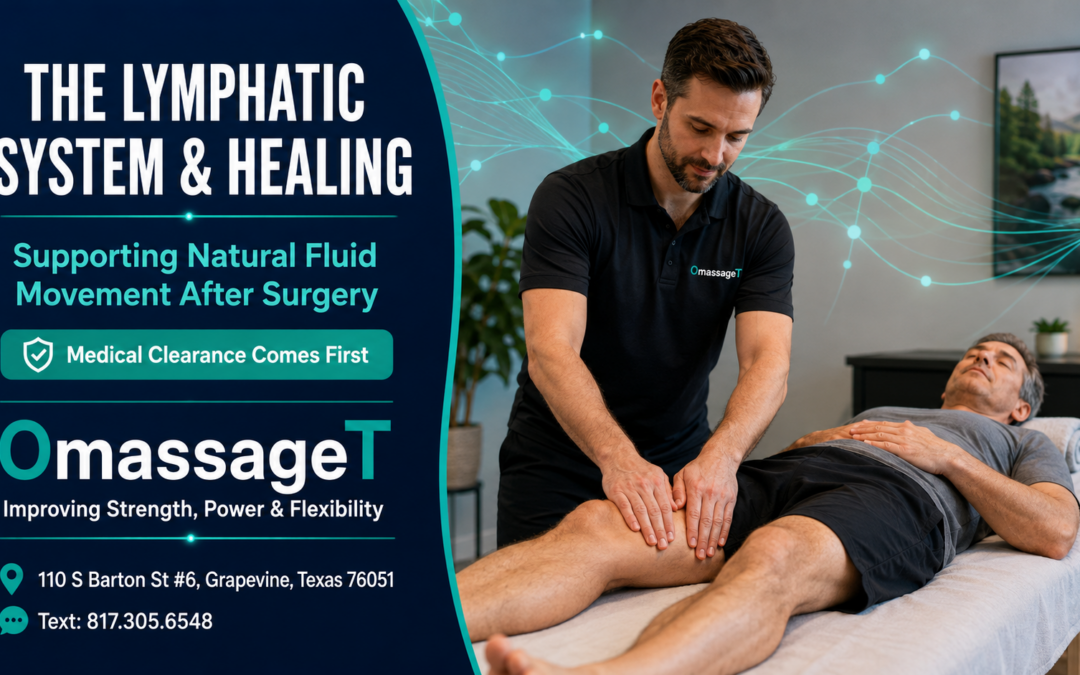
Swelling and Recovery: Understanding the Body’s Need for Circulation
Swelling can be an important part of the body’s response to injury, surgery, inflammation and changes in activity.
Sometimes swelling is temporary and gradually improves as the body recovers.
Other times, swelling can persist and may require medical evaluation.
For people recovering from an injury or orthopedic surgery, understanding swelling and the body’s fluid systems can be an important part of the recovery process.
At OmassageT.com, I use a comfortable, pain-free approach and, when appropriate, incorporate techniques intended to support the body’s natural lymphatic pathways.
What Is Swelling?
Swelling occurs when excess fluid accumulates in tissues.
It can happen for many different reasons.
An injury can produce swelling around the affected area.
Surgery can also result in swelling during the healing process.
Standing or sitting for long periods may contribute to swelling in some people.
There are also medical conditions that can cause swelling.
Because the causes vary, swelling should not automatically be assumed to be a simple circulation problem.
The Body Has a Fluid Management System
The body continuously moves fluid through tissues and vessels.
The cardiovascular system circulates blood.
The lymphatic system helps collect and transport excess fluid and plays important roles in immune function.
These systems work together to maintain fluid balance.
Movement also matters.
Muscle contractions can help support the movement of fluid through the body.
This is one reason regular, appropriate movement is an important part of recovery.
Why Movement Matters
When people are active, their muscles repeatedly contract and relax.
That movement contributes to normal circulation and fluid movement.
After an injury or surgery, however, activity may be reduced.
A person may spend more time sitting or lying down.
They may also avoid putting weight on one side.
Those changes can affect normal movement patterns and may contribute to feelings of heaviness or swelling.
Swelling After Surgery
Swelling can occur after many types of orthopedic surgery.
The amount and duration can vary considerably.
The surgical team should provide specific instructions regarding what is expected during recovery.
If swelling is increasing, severe, accompanied by significant pain or associated with other concerning symptoms, medical evaluation may be necessary.
Massage should never be used to assume that unexpected swelling is harmless.
The Lymphatic System
The lymphatic system is a network of vessels, tissues and organs involved in fluid balance and immune function.
Lymph moves through lymphatic vessels and eventually returns to the bloodstream.
Unlike the heart, the lymphatic system does not have a single central pump.
Movement of the body and surrounding muscle activity can contribute to lymph movement.
This is one reason gentle movement can be an important part of many recovery programs.
Supporting Lymphatic Pathways
In my work, I sometimes focus on opening or working with key areas of the body that are part of the lymphatic system.
The techniques are gentle and comfortable.
The intention is to support the body’s natural processes rather than force fluid through the tissues.
I have had clients report that swelling or puffiness felt reduced after sessions.
These experiences are individual and do not mean that massage will produce the same result for everyone.
Swelling Around the Ankles
Ankle swelling is something I have encountered in my practice.
Some clients have reported noticing reduced swelling after their first or second visit.
There can be many reasons for ankle swelling, however.
It may be related to injury, prolonged standing or sitting, surgery, medications or an underlying medical condition.
For that reason, persistent or unexplained swelling should be evaluated appropriately.
Massage should not be used as a substitute for finding the cause.
Puffiness Around the Clavicle
I have also worked with clients who noticed puffiness around the clavicle area.
In some cases, clients have reported changes in the appearance or feeling of puffiness after treatment.
The clavicle region is near important lymphatic structures.
However, swelling around the neck or clavicle can have many possible causes.
New, unexplained or persistent swelling in this area should be evaluated by a healthcare professional.
Massage should not be used to diagnose the cause.
Why Gentle Work Matters
When working with the lymphatic system, aggressive pressure is generally not the goal.
Lymphatic techniques are typically performed gently.
The purpose is to work with the body’s natural pathways rather than forcefully manipulate tissue.
This fits naturally with my approach to pain-free orthopedic massage.
Comfort matters.
Recovery After an Injury
An injury can temporarily change how a person moves.
Someone may avoid using one leg.
They may reduce activity.
They may spend more time sitting.
They may use crutches or another assistive device.
All of these changes can affect the way the body handles normal movement and fluid circulation.
As appropriate movement gradually returns, the body may also return to its normal activity patterns.
Recovery After Orthopedic Surgery
Post-surgical recovery is another situation where swelling can be present.
The exact recovery process depends on the procedure.
A person recovering from knee surgery has different needs from someone recovering from shoulder surgery.
The surgeon or medical team should determine when massage is appropriate.
If massage is approved, techniques should be adapted to the individual’s stage of recovery.
Massage Is Not a Treatment for Every Cause of Swelling
This is an important distinction.
Swelling can have many causes.
Some are related to normal recovery.
Others can require medical treatment.
Swelling associated with a blood clot, infection, heart or kidney problems, medication effects or another medical condition requires appropriate medical evaluation.
Massage should not be used to mask symptoms that need medical attention.
Warning Signs That Need Medical Attention
A person should seek appropriate medical evaluation for unexplained or concerning swelling, especially when it occurs with symptoms such as:
- Significant pain
- Redness or warmth
- Fever
- Sudden swelling
- One-sided swelling that is new or unusual
- Shortness of breath
- Chest pain
- Sudden weakness
- Significant loss of function
These symptoms should not simply be treated as muscle tightness.
The Relationship Between Swelling and Movement
Swelling can sometimes affect how a person moves.
An ankle that feels swollen may not move comfortably.
A swollen knee may change how someone walks.
A person recovering from surgery may move differently because of both pain and swelling.
This can lead to additional areas of the body working differently.
The whole-body movement pattern can therefore become important during recovery.
Balance and Stability During Recovery
When swelling affects a person’s movement, balance can sometimes change.
For example, someone with a swollen ankle may unconsciously shift weight toward the other leg.
Someone recovering from knee surgery may avoid loading the surgical side.
These adaptations can be natural.
As recovery progresses, appropriate rehabilitation can help restore strength, balance and stability.
Massage can complement that process when appropriate.
The Core and Pelvis Still Matter
Even when swelling is located in a lower extremity, the rest of the body remains involved in movement.
The pelvis and core help stabilize the body while walking.
If someone is favoring one leg, the pelvis may move differently.
The trunk may also make adjustments.
This is another reason I look at the whole body rather than treating every problem as an isolated body part.
Comfortable Movement During Recovery
My approach is focused on comfortable movement.
I do not believe recovery work needs to be painful.
When massage is appropriate, I work within the person’s comfort level and adapt the session to their situation.
The goal is not to force movement or aggressively work on swollen tissues.
The goal is to support the body while respecting the recovery process.
Hydration, Movement and Recovery
Healthy recovery involves more than massage.
Appropriate hydration, nutrition, sleep and movement all matter.
The exact recommendations depend on the individual and their medical situation.
For someone recovering from surgery or an injury, the healthcare team’s instructions should take priority.
Massage is one potential component of a larger recovery plan.
The Importance of Individualized Care
Two people can have similar-looking swelling but very different causes.
One person may be recovering from surgery.
Another may have experienced an injury.
Another may have swelling related to prolonged standing.
Another may have an underlying medical condition.
This is why swelling should never automatically be treated the same way.
Understanding the person’s history is important.
How I Approach Recovery Work
When I work with someone who is recovering from an injury or surgery, I want to understand the bigger picture.
What happened?
When did it happen?
What treatment has already been provided?
What does the medical team recommend?
How is the person moving?
Where do they feel restricted?
What areas feel uncomfortable?
These questions help determine what is appropriate within the scope of massage therapy.
Supporting the Body’s Natural Processes
The body is constantly working to maintain balance.
It regulates fluid.
It repairs tissues.
It adapts to physical demands.
It responds to movement.
Massage cannot control these processes.
But when appropriate, comfortable hands-on work can be one way of supporting a person’s overall recovery routine.
Improving Strength, Power and Flexibility
At OmassageT.com, my larger philosophy is:
Improving Strength, Power and Flexibility.
Recovery can involve these qualities as well.
As swelling and discomfort improve, an individual may gradually return to:
Mobility.
Balance.
Stability.
Strength.
Flexibility.
The process should be appropriate for the individual’s condition and recovery plan.
A Whole-Body Approach to Recovery
Swelling may appear in one specific area, but the body’s response to that swelling can involve many other areas.
Movement can change.
Balance can change.
The way the pelvis moves can change.
Muscles may work differently.
Daily activities may become different.
That is why I take a whole-body approach.
The goal is not simply to focus on the visible symptom.
It is to understand the person and how their body is moving.
Massage Therapy in Grapevine, Texas
At OmassageT.com, I provide pain-free orthopedic massage therapy for clients in Grapevine and the surrounding area.
My approach can include comfortable work focused on movement, soft-tissue restrictions and, when appropriate, techniques intended to support the body’s natural lymphatic pathways.
If you have unexplained, sudden or concerning swelling, medical evaluation should come first.
When massage is appropriate, it can be one component of a larger approach to recovery.
Orthopedic Massage Therapy in Grapevine, Texas
OmassageT.com
110 S Barton #6
Grapevine, Texas 76051
817-305-6548
Improving Strength, Power and Flexibility
Pain Relief by Improving/Repairing Core Performance