Why Some People Feel More Relaxed After Orthopedic Massage Therapy
People often think of massage as something that is supposed to make a tight muscle feel better.
That can certainly be part of the experience.
But there is another response that many people notice after a massage session:
Relaxation.
Some clients describe feeling calmer.
Others say they feel lighter, more comfortable or more open.
Some people tell me they sleep more deeply after a session.
For others, the biggest difference is simply that their body feels less tense.
At OmassageT.com, relaxation is an important part of my pain-free orthopedic massage approach.
Why Does Relaxation Matter?
When someone is experiencing pain or physical discomfort, the body may become guarded.
A person may tense muscles without realizing it.
They may change how they sit.
They may alter how they walk.
They may hold their shoulders differently.
They may breathe differently.
These changes can become part of how the body responds to discomfort.
Creating a comfortable environment can give the person an opportunity to let go of some of that unnecessary tension.
Pain and Muscle Tension Can Be Connected
Pain and muscle tension are not exactly the same thing, but they can influence one another.
When something hurts, people often protect the area.
That protection can involve tightening surrounding muscles.
If the person continues to experience discomfort, the body may continue to use protective movement patterns.
This does not mean that muscle tension is always the cause of pain.
There can be many causes of pain.
But tension can be one part of the overall experience.
Why I Use a Pain-Free Approach
Some people believe that massage needs to hurt in order to be effective.
I take a different approach.
My orthopedic massage work is pain-free.
I want the client to be comfortable enough to communicate throughout the session.
If something feels uncomfortable, the pressure or technique can be adjusted.
The goal is not to make someone tolerate pain.
The goal is to work with the body.
Relaxation Can Make Movement Easier
When someone is relaxed, they may be able to move more comfortably.
Imagine trying to stretch while consciously tightening every muscle.
It becomes difficult.
Now imagine allowing the body to relax while moving through the same position.
The experience can be very different.
This is one reason relaxation can be valuable during orthopedic massage.
The Nervous System and Relaxation
The nervous system plays a major role in how the body responds to its environment.
Stress, pain, fear and physical discomfort can influence how the body feels and behaves.
A quiet environment, comfortable positioning and appropriate touch can create conditions that encourage relaxation.
Massage does not control the nervous system.
But the experience of safe, comfortable touch can contribute to a person’s sense of relaxation.
Breathing Can Change When We Relax
Breathing is closely connected with how the body feels.
When people are stressed, they may breathe differently.
When they become more relaxed, their breathing may naturally become slower and easier.
The diaphragm is also an important part of the body’s movement system.
It participates in breathing and interacts with structures around the core and trunk.
This is one reason I pay attention to breathing as part of whole-body movement.
The Diaphragm and the Core
The diaphragm is often thought of only as a breathing muscle.
But it is also part of the body’s core system.
The diaphragm works together with other muscles involved in trunk control.
Breathing and core stability therefore have an important relationship.
When someone is able to breathe comfortably and relax, it can change how they experience movement.
Relaxation and the Pelvis
The pelvis is another important part of the body’s movement system.
The hips connect to the pelvis.
The pelvis connects with the spine.
The core helps stabilize the area.
When someone is tense or uncomfortable, their posture and movement can change.
A comfortable massage session can provide an opportunity to become more aware of these areas.
Why People Sometimes Feel “Lighter”
After massage, some people describe feeling lighter.
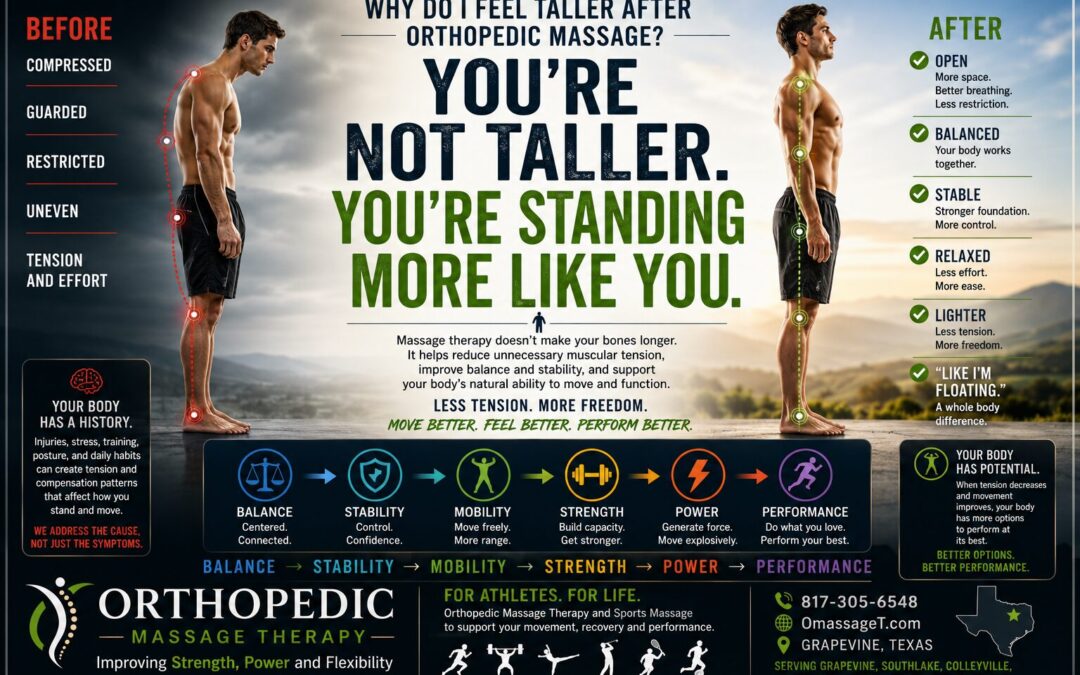
Others say they feel taller or more open.
Some even describe the sensation as feeling like they are floating.
These are individual experiences.
Massage does not physically make someone taller.
However, when someone relaxes and changes the way they hold their body, they may perceive themselves as more open or upright.
Their actual height has not changed.
Their posture and body awareness may simply feel different.
Feeling Taller Without Actually Growing Taller
This is something I have heard from clients.
They may stand up after a session and say:
“I feel taller.”
I explain that they have not actually grown taller.
Their bones have not suddenly become longer.
Instead, they may be standing differently.
If someone has been holding tension or guarding a painful area, they may have been slightly compressed or protective in their posture.
When that tension decreases, their body may feel more open.
Why Some People Feel Like They Are Floating
The “floating” sensation is another description some people use after a relaxing session.
It can be difficult to describe exactly.
People may simply feel lighter, calmer or less physically restricted.
Again, this is an individual experience.
It does not mean that the body has physically changed in a dramatic way.
It may reflect a combination of relaxation, movement, posture and body awareness.
Relaxation and Sleep
Some clients report sleeping more deeply after massage.
There are several possible reasons someone may feel more relaxed after a session.
They may simply be physically calmer.
They may have less awareness of muscle tension.
They may have taken time away from daily stress.
Massage can create a quiet period where the person is able to slow down.
However, massage should not be presented as a treatment for sleep disorders.
Persistent sleep problems should be discussed with an appropriate healthcare professional.
Relaxation Is Not the Same as Being Weak
Some athletes worry that relaxation means losing strength.
It does not.
Athletes need to be able to produce force and control movement.
They also need to know how to recover.
A body that is constantly tense is not necessarily a stronger body.
Performance requires the ability to produce force when needed and relax when force is no longer necessary.
Athletes Need Relaxation Too
Athletes experience physical and mental demands.
Training can be intense.
Competition can be stressful.
The body may accumulate fatigue.
Recovery therefore becomes important.
Massage may provide an opportunity for an athlete to slow down and pay attention to their body.
For some athletes, that is valuable simply because training rarely gives them time to stop.
Relaxation During Recovery
People recovering from an injury or surgery may also experience tension.
They may be nervous about movement.
They may protect a particular area.
They may spend more time in one position.
When massage is medically appropriate, comfortable hands-on work can provide an opportunity to relax while the body is recovering.
The medical and rehabilitation team’s restrictions should always come first.
Relaxation and Pain-Free Massage
One of the reasons I emphasize pain-free work is that comfort matters.
If a client is constantly bracing against painful pressure, it can be difficult to truly relax.
I want clients to feel comfortable enough to communicate.
That allows me to adjust pressure and positioning when necessary.
The session becomes a conversation between the therapist and the client’s body.
Myofascial Work and Relaxation
Fascia is connective tissue that surrounds and connects many structures throughout the body.
Some clients describe areas of fascia or soft tissue as feeling restricted or bound up.
Myofascial techniques can be incorporated into a session when appropriate.
The work is performed in a way that respects the client’s comfort.
The goal is not to force tissue.
It is to work gradually and comfortably with areas of restriction.
Relaxation and Whole-Body Movement
Relaxation does not mean ignoring movement.
In fact, it can help an individual become more aware of movement.
When someone is relaxed, they may notice:
-
How they are breathing
-
How they are standing
-
How their shoulders feel
-
How their hips move
-
How they distribute weight
-
Whether one side feels different from the other
That awareness can be useful.
Balance and Stability
Relaxation and stability may sound like opposites.
They are not.
A stable body does not need every muscle to remain tense all the time.
Good movement involves knowing when to stabilize and when to release.
An athlete needs to stabilize during certain movements and relax between them.
Everyday movement works similarly.
The goal is appropriate control—not constant tension.
Improving Strength, Power and Flexibility
My philosophy at OmassageT.com is:
Improving Strength, Power and Flexibility.
But these qualities work alongside:
Balance.
Stability.
Mobility.
Recovery.
Relaxation.
The body needs both the ability to produce force and the ability to let go of unnecessary tension.
When Relaxation Can Be Especially Helpful
People may seek a massage session when they feel:
-
Physically tense
-
Stiff from sitting
-
Tired after training
-
Tight after exercise
-
Stressed by daily activity
-
Restricted in movement
-
In need of quiet recovery time
These experiences can have many causes.
Massage may be appropriate for some people, while others may need medical evaluation or another type of care.
Knowing When Massage Is Not Enough
Massage is not appropriate for every situation.
Persistent or severe pain, significant swelling, weakness, numbness, unexplained symptoms or an acute injury may require medical evaluation.
Massage should not be used to delay necessary medical care.
As a massage therapist, I work within my scope of practice.
My goal is to provide comfortable hands-on care and recognize when another healthcare professional should be involved.
A Comfortable Environment Matters
Relaxation begins before the massage itself.
The client should feel comfortable communicating.
Positioning should be appropriate.
The person should feel respected and covered appropriately.
The therapist should explain what is being done.
These simple things can make a significant difference in the experience.
The Goal Is to Help the Body Let Go
A pain-free approach allows the session to focus on comfortable movement rather than simply applying more pressure.
For some clients, that may mean working with areas of soft-tissue restriction.
For others, it may simply mean having time to relax.
Every person’s response is different.
The goal is to listen to the body and adjust accordingly.
Orthopedic Massage in Grapevine, Texas
At OmassageT.com, I provide pain-free orthopedic massage therapy with an emphasis on comfortable movement, whole-body balance and relaxation.
My approach considers the relationship between the:
Feet
Legs
Hips
Pelvis
Core
Spine
Shoulders
Relaxation is not separate from movement.
Sometimes, allowing the body to relax can be an important part of helping a person become more aware of how they move.
Orthopedic Massage Therapy in Grapevine, Texas
OmassageT.com
110 S Barton #6
Grapevine, Texas 76051
817-305-6548
Improving Strength, Power and Flexibility
Pain Relief by Improving/Repairing Core Performance