Massage Therapy and Mobility After an Injury
After an injury, getting back to normal movement can take time.
Even after the initial injury has healed, a person may notice that certain movements still feel different. A joint may not move as freely. A muscle may feel restricted. One side of the body may feel different from the other.
For athletes, this can be especially noticeable when returning to running, lifting, jumping or changing direction.
For everyday clients, it may show up when walking, standing, sitting, reaching or getting in and out of a chair.
Mobility is an important part of moving forward after an injury.
At OmassageT.com, my orthopedic massage approach focuses on comfortable, pain-free work and looking at how different areas of the body contribute to movement.
What Is Mobility?
Mobility is the ability to move a body part through its available range of motion with control.
It is different from simply being flexible.
For example, someone may be able to stretch their hamstrings very far but still have difficulty controlling certain movements.
Good mobility involves both available movement and the ability to use that movement appropriately.
Why Mobility Can Change After an Injury
There are many reasons mobility may change after an injury.
A person may have:
-
Reduced activity
-
Swelling
-
Muscle tension
-
Protective movement patterns
-
A period of immobilization
-
Changes in strength
-
Changes in balance
-
Changes in how they use the injured area
The exact reason depends on the injury and the individual.
This is why recovery should be individualized.
The Body May Become Protective
When an area has been injured, a person may naturally become more cautious with movement.
They may avoid a particular position because it does not feel comfortable.
They may move more slowly.
They may use another part of the body to compensate.
This can be part of the normal recovery process.
As healing progresses, however, the person may need to gradually regain comfortable movement and confidence.
Mobility Is More Than Stretching
Stretching can be useful for some people, but mobility involves more than stretching.
Movement also requires:
Strength.
Control.
Balance.
Stability.
Coordination.
An athlete returning from an injury needs to be able to control the movement—not simply reach a certain range.
This is one reason rehabilitation often combines mobility exercises with strengthening and functional movement.
How Orthopedic Massage Can Complement Recovery
Massage therapy can be one part of a broader recovery process when appropriate.
During an orthopedic massage session, I may work with areas of soft-tissue tension or restriction that are affecting comfortable movement.
The goal is not to force a joint into a range of motion.
Instead, the focus is on comfortable work with the surrounding tissues.
Massage does not replace rehabilitation, but it may complement an individual’s recovery plan.
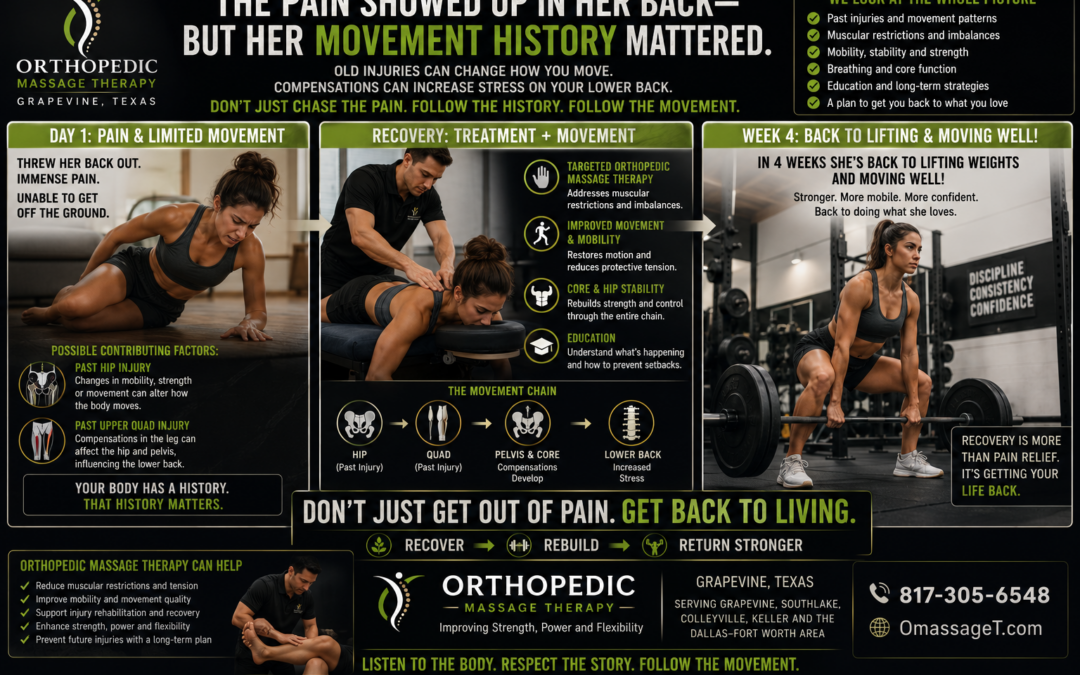
Looking Beyond the Injured Area
One of the most important concepts in movement is that the body works together.
If an ankle is injured, the person may change how they walk.
That change can affect the knee.
The knee is connected to the hip.
The hip works with the pelvis.
The pelvis works with the spine and core.
This does not mean that a problem in one area was necessarily caused by another area.
It means that movement involves relationships between many parts of the body.
The Foot and Ankle
The foot is the foundation for many activities.
Walking, running and jumping all involve contact with the ground.
After an ankle or foot injury, a person may change how they place their foot or distribute their weight.
As recovery progresses, restoring comfortable movement through the foot and ankle can become important.
The appropriate exercises and progression should come from the individual’s rehabilitation plan.
The Knee, Hip and Pelvis
The knee sits between the ankle and hip and participates in transferring forces through the lower body.
Above the knee is the hip, which connects the leg to the pelvis.
The pelvis then connects the lower body with the spine.
When an athlete or client changes how they move because of an injury, these relationships can change.
This is why I consider the surrounding areas when working with clients.
The Core and Movement
The core is more than the abdominal muscles.
It contributes to trunk control and helps connect movement between the upper and lower body.
When someone is recovering from a lower-body injury, the way they use their core may change as they adapt their movement.
Likewise, an upper-body injury can influence posture and trunk movement.
The core is therefore part of the larger movement picture.
Old Injuries Can Still Influence Mobility
A previous injury can remain part of a person’s movement history.
An athlete may have returned to their sport but continued to move slightly differently.
Someone may have developed a habit of standing more heavily on one side.
Another person may avoid a particular position without consciously realizing it.
This does not necessarily mean the old injury is still damaged.
It means the body may have developed a different movement strategy.
Understanding that history can be useful when looking at current mobility.
Fascia and Restricted Movement
Fascia is connective tissue that surrounds and connects many structures throughout the body.
People sometimes describe certain areas as feeling tight, restricted or “bound up.”
When appropriate, I may incorporate myofascial techniques into an orthopedic massage session.
The intention is to work comfortably with areas of soft-tissue restriction.
The goal is not to force the body.
Pain-Free Orthopedic Massage
My approach is based on pain-free orthopedic massage.
I do not believe that a client needs to experience painful pressure for massage to be meaningful.
Comfort allows the client to communicate throughout the session.
If something does not feel right, the pressure, position or technique can be changed.
The session should be adapted to the person.
Mobility and Balance
Mobility and balance work together.
A person may have enough range of motion to perform a movement but still have difficulty controlling it.
This can become particularly important after an injury.
For example, someone recovering from an ankle injury may have regained the ability to move the ankle but still feel uncertain when standing on that leg.
Rehabilitation can address these challenges through appropriate exercises.
Massage can complement that work when appropriate.
Mobility and Stability
Mobility allows movement.
Stability helps control movement.
Both are important.
An athlete needs enough mobility to get into position and enough stability to control that position.
This is particularly important for sports that involve:
-
Sprinting
-
Jumping
-
Landing
-
Cutting
-
Rotating
-
Throwing
-
Rapid changes of direction
Recovery should gradually prepare the body for the demands it will eventually need to handle.
Mobility After Surgery
Orthopedic surgery can temporarily change mobility.
Depending on the procedure, there may be restrictions on movement, weight bearing or positioning.
Those restrictions must be followed.
Massage should only be considered when it is appropriate and consistent with the recommendations of the surgical and rehabilitation team.
When massage is approved, the session can be adapted to the person’s stage of recovery.
Swelling Can Affect Movement
Swelling can make movement uncomfortable or restricted.
A swollen knee, ankle or other area may not move the same way it normally does.
Swelling after surgery or injury should be monitored according to the individual’s medical instructions.
Unexpected, severe or worsening swelling should be evaluated by an appropriate healthcare professional.
Massage should never be used to assume that unexplained swelling is harmless.
Supporting Comfortable Movement
My goal during an orthopedic massage session is not to force a client into a movement.
Instead, I want the body to be comfortable.
That may involve working with surrounding muscles and soft tissues.
It may involve changing positioning.
It may involve allowing the client to relax into a comfortable position.
Every person’s situation is different.
Returning to Exercise
Returning to exercise after an injury should be gradual.
A runner may progress from walking to jogging and eventually running.
An athlete may progress from basic strength exercises to sport-specific movements.
Someone recovering from surgery may have a completely different progression.
The appropriate timeline should come from the healthcare professionals managing the recovery.
Returning to Sports
Athletes often want to return as quickly as possible.
But returning to sport requires more than simply feeling better.
The athlete may need to rebuild:
Strength.
Power.
Mobility.
Balance.
Stability.
Coordination.
Sport-specific conditioning.
Massage can be one component of an athlete’s overall recovery and maintenance routine when appropriate.
Mobility and Performance
Mobility is not only important after an injury.
It is also part of athletic performance.
A runner needs appropriate movement through the hips and ankles.
A football player needs to accelerate, decelerate and change direction.
A gymnast needs controlled movement through large ranges.
A baseball player needs to rotate.
Every sport places different demands on the body.
Why the Whole Body Matters
The body does not move as a collection of completely separate parts.
Movement involves relationships.
The feet interact with the ground.
The legs transfer forces.
The hips and pelvis help connect the lower body with the trunk.
The core helps control the center of the body.
The upper body contributes to balance and movement.
This is why my approach looks beyond the location where someone says they feel tight.
Improving Strength, Power and Flexibility
At OmassageT.com, my philosophy is:
Improving Strength, Power and Flexibility.
These qualities work together with:
Mobility.
Balance.
Stability.
Recovery.
The goal is not simply to stretch a tight muscle.
It is to understand how the body is moving and support comfortable movement within the scope of massage therapy.
When Massage Is Not the Right First Step
Massage is not appropriate for every injury.
If you have a new or serious injury, significant swelling, numbness, weakness, loss of function, severe pain or difficulty bearing weight, medical evaluation may be necessary.
People recovering from surgery should follow the instructions of their surgical and rehabilitation teams.
Massage therapy does not diagnose or replace medical care.
Listening to Your Body During Recovery
Recovery requires patience.
Pay attention to how your body responds to movement.
Notice changes in mobility.
Notice differences between the sides.
Notice whether a movement is becoming easier or more difficult.
If something is getting worse rather than better, seek appropriate professional evaluation.
The goal is not to push through every sensation.
The goal is to gradually restore appropriate movement.
From Injury Recovery to Better Movement
An injury can temporarily change how a person moves.
Recovery provides an opportunity to gradually rebuild movement, strength and confidence.
With appropriate medical care, rehabilitation, training and recovery strategies, a person can work toward returning to the activities that matter to them.
Massage may be one part of that process.
My role is to provide comfortable, pain-free orthopedic massage while respecting the individual’s condition and the recommendations of their healthcare team.
Orthopedic Massage and Mobility in Grapevine, Texas
At OmassageT.com, I provide pain-free orthopedic massage therapy with an emphasis on comfortable movement and a whole-body perspective.
Whether you are recovering from an injury, returning to exercise or looking to maintain mobility, the goal is to work with the body rather than force it.
OmassageT.com
110 S Barton #6
Grapevine, Texas 76051
817-305-6548
Improving Strength, Power and Flexibility
Pain Relief by Improving/Repairing Core Performance