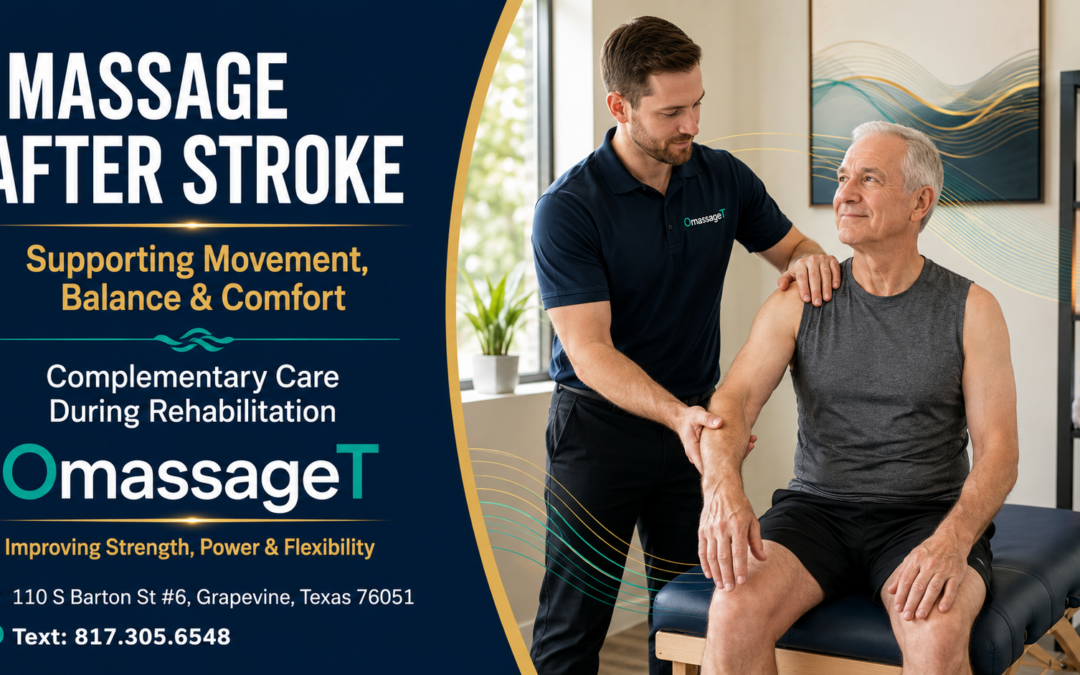
Supporting Movement After a Stroke: The Role of Relaxation, Balance and Stability
A stroke can change the way a person moves.
Movement that once felt automatic may suddenly require more concentration. Balance can become more difficult. One side of the body may feel different from the other. Everyday activities can require more effort.
Stroke recovery is highly individual, and rehabilitation can involve many different healthcare professionals and therapies.
In my experience working with stroke patients, I have seen how important comfort, relaxation, balance and stability can be when supporting movement.
At OmassageT.com, my role is to provide pain-free orthopedic massage within the scope of massage therapy. Massage does not replace medical care or stroke rehabilitation, but it may be used as complementary care when appropriate and approved by the person’s healthcare team.
Every Stroke Recovery Is Different
A stroke can affect different areas of the brain and can result in different physical challenges.
One person may experience changes in movement.
Another may have difficulty with balance.
Someone else may experience changes in coordination or muscle control.
Because every stroke is different, there is no single massage approach or recovery plan that applies to everyone.
The person’s medical and rehabilitation team should guide their overall recovery.
Movement Can Become More Difficult
After a stroke, a person may have difficulty with movements that were previously simple.
Standing up may require more effort.
Walking may feel different.
Changing positions may take longer.
Balance may become a concern.
These changes can affect confidence as well as physical movement.
The goal of rehabilitation is often to help the individual regain as much safe and functional movement as possible.
The Importance of Balance
Balance is an important part of everyday life.
We need balance when standing, walking, turning, reaching and changing positions.
For someone recovering from a stroke, balance may become more challenging.
This can increase the need for appropriate rehabilitation and safety precautions.
Massage does not replace balance training.
However, when appropriate, comfortable bodywork can be part of a broader approach to supporting the person’s comfort and awareness of their body.
Stability and Movement
Stability is another important part of movement.
The body needs to control itself while moving from one position to another.
For example, getting out of a chair requires coordination between the feet, legs, pelvis and trunk.
Walking requires the body to continually adjust its balance.
After a stroke, these movements may require more concentration.
Rehabilitation professionals can work specifically on these skills.
Relaxation Can Be Important
One thing I have noticed in my work with stroke patients is the importance of relaxation.
Some patients and caregivers have reported improvements such as:
-
Easier movement
-
Improved balance or stability
-
Greater relaxation
-
Greater comfort
These are individual experiences and should not be interpreted as guaranteed results from massage.
For me, these observations reinforce the importance of creating a comfortable environment where the person can feel supported.
Why I Use a Pain-Free Approach
My orthopedic massage work is designed to be pain-free.
I do not believe a person needs to experience painful pressure for massage to be useful.
This is particularly important when working with someone who may already be dealing with physical limitations or increased sensitivity following a stroke.
The client should be able to communicate throughout the session.
Positioning, pressure and techniques can be adjusted according to the individual’s needs and the guidance provided by their healthcare team.
Supporting Comfortable Movement
Massage is not about forcing movement.
Instead, the focus can be on comfortable positioning and working with appropriate soft tissues.
Depending on the individual’s condition, this may involve areas around the:
-
Shoulders
-
Arms
-
Back
-
Hips
-
Legs
-
Feet
The approach needs to be individualized.
What is appropriate for one stroke survivor may not be appropriate for another.
The Whole Body Still Works Together
Even when a stroke affects one side of the body, movement involves the entire body.
The feet interact with the ground.
The legs support the body.
The pelvis connects the lower body with the trunk.
The core helps provide stability.
The spine connects the upper and lower body.
The shoulders and arms contribute to balance and movement.
Looking at the whole body does not mean assuming that every area is causing a person’s difficulties.
It means recognizing that movement is a coordinated process.
The Core and Stability
The core is more than the abdominal muscles.
It is part of the body’s system for controlling the trunk.
Trunk control can be important when sitting, standing and moving.
After a stroke, rehabilitation may include exercises designed to improve trunk control, balance and functional movement.
Massage cannot replace these exercises.
But when appropriate, massage may complement the person’s overall care.
The Connection Between Relaxation and Movement
Movement can sometimes become easier when a person feels comfortable and relaxed.
This does not mean relaxation cures a neurological condition.
It simply recognizes that physical tension and discomfort can affect how a person experiences movement.
Creating a calm environment can allow the person to focus on the movement experience without unnecessary discomfort.
A Comfortable Position Matters
Positioning is especially important when working with someone who has movement limitations.
The person may need additional support.
A particular position may not be comfortable.
The therapist may need to make adjustments throughout the session.
My goal is to make sure the client is supported and comfortable rather than forcing the body into a position.
Communication Is Essential
Communication becomes especially important when working with someone recovering from a stroke.
The client may need to communicate:
-
If something hurts
-
If a position is uncomfortable
-
If they need to change positions
-
If pressure is too much
-
If something feels different
Caregivers may also provide valuable information about the person’s normal movement and comfort.
The session should be collaborative.
Working With Caregivers
Caregivers often play an important role in stroke recovery.
They may notice changes that are difficult to recognize during a single session.
They may know how the person normally moves.
They may also communicate concerns or observations to the healthcare team.
When appropriate, communication between the client, caregiver and healthcare professionals can help keep the person’s care coordinated.
Massage and Stroke Rehabilitation
Stroke rehabilitation may involve physical therapy, occupational therapy, speech therapy, medical management and other forms of care depending on the individual’s needs.
Massage therapy is different.
Massage therapists do not provide neurological rehabilitation or diagnose the effects of a stroke.
Instead, massage may provide complementary hands-on care when it is medically appropriate.
The person’s healthcare team should determine whether massage is appropriate.
Why Balance and Stability Matter Outside the Treatment Room
The goal is not simply for someone to feel better while lying on a massage table.
Movement matters in everyday life.
It matters when getting dressed.
It matters when getting out of bed.
It matters when standing from a chair.
It matters when walking through the house.
It matters when participating in family activities.
Balance and stability are part of independence and safety.
Progress Can Look Different for Everyone
Recovery does not always happen in a straight line.
One person may make noticeable improvements quickly.
Another may progress more gradually.
Some days may feel easier than others.
Small changes can still be meaningful.
A movement that once required assistance may eventually become easier.
A person may feel more comfortable standing.
A caregiver may notice improved stability.
These individual changes can be important parts of the recovery process.
What I Have Observed
Through my experience working with stroke patients, I have heard reports of:
Easier movement.
Improved balance or stability.
Greater relaxation.
Greater comfort.
These observations are important to me because they show how individual each person’s experience can be.
They are not promises of a particular outcome.
Stroke recovery depends on many factors, and massage should always be considered within the person’s overall medical and rehabilitation plan.
Pain-Free Work and Respect for the Individual
My approach is based on respecting the person in front of me.
I do not believe in forcing a painful technique simply because someone has a physical limitation.
Comfort matters.
Communication matters.
Positioning matters.
The person’s medical history matters.
Most importantly, the person’s safety matters.
When Medical Guidance Is Necessary
Anyone who has recently experienced a stroke should follow the recommendations of their medical and rehabilitation team.
New or worsening neurological symptoms require immediate medical attention.
Massage should never delay emergency care.
A massage therapist should also be informed about relevant medical conditions, medications and restrictions so that the session can be approached appropriately.
Supporting the Person, Not Just the Movement
A stroke affects more than movement.
It can affect confidence, independence and daily life.
That is why I believe the person should always come before the technique.
A massage session should be comfortable.
The person should feel respected.
Their individual needs should guide the session.
A Whole-Body Perspective
At OmassageT.com, I look at movement as a relationship between different parts of the body.
The feet.
The legs.
The hips.
The pelvis.
The core.
The spine.
The shoulders.
The arms.
The way these areas interact can influence how a person experiences movement.
That does not mean massage can reverse the effects of a stroke.
It means that when massage is appropriate, the session can consider the whole person rather than focusing only on one area.
Orthopedic Massage in Grapevine, Texas
My work with stroke patients has reinforced something I see throughout orthopedic massage:
Movement matters.
Balance matters.
Stability matters.
Comfort matters.
Relaxation matters.
And every person deserves an individualized approach.
Massage therapy is not a replacement for stroke rehabilitation or medical care. When it is appropriate and approved by the healthcare team, however, comfortable hands-on work may serve as one part of a person’s broader recovery and wellness plan.
At OmassageT.com, my approach is focused on pain-free orthopedic massage, comfortable movement and supporting the body’s ability to move with greater ease.
Orthopedic Massage Therapy in Grapevine, Texas
OmassageT.com
110 S Barton #6
Grapevine, Texas 76051
817-305-6548
Improving Strength, Power and Flexibility
Pain Relief by Improving/Repairing Core Performance