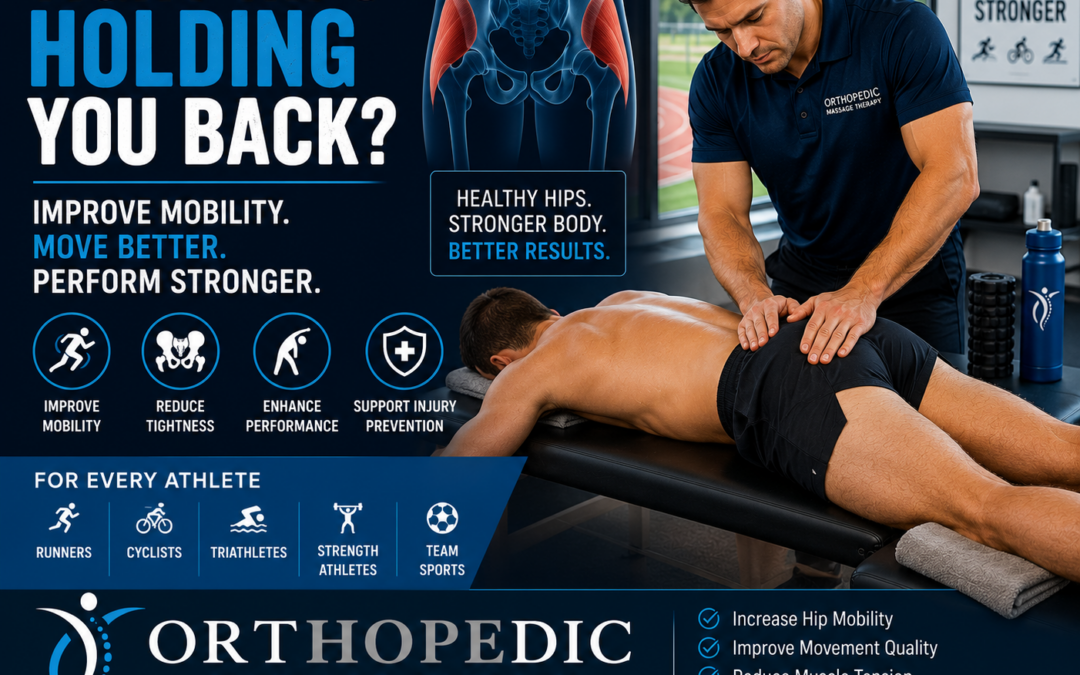
Hip Pain and Running: Why the Problem May Not Be Where You Feel It
Running places demands on the entire body.
With every stride, your feet, ankles, knees, hips, pelvis and core work together to create movement and stability.
So when a runner feels pain around the hip, it can be tempting to assume that the hip itself is the entire problem.
Sometimes it is.
But the location where you feel discomfort does not always tell the entire story about how your body is moving.
At OmassageT.com, my approach to orthopedic massage therapy looks at the body as a connected system. The goal is to understand movement, balance, stability and areas of tension rather than simply focusing on the location where someone feels discomfort.
Hip Pain Can Change the Way You Run
When something hurts, runners often change their movement without realizing it.
You might shorten your stride.
You might favor one leg.
You might change the way your foot lands.
You might rotate your pelvis differently.
You might put more pressure on one side of your body.
These changes can be your body’s natural attempt to protect an uncomfortable area.
But changing the way you move can also affect other parts of the body.
The Running Movement Chain
Running is not just a hip movement.
Your body works through a chain that includes:
-
Feet
-
Ankles
-
Knees
-
Hips
-
Pelvis
-
Core
-
Spine
-
Shoulders and arms
Each area contributes to the movement of the whole body.
This is one reason I don’t automatically assume that the location of pain is the only area that needs attention.
The Feet and Ankles Matter
Every running stride begins with contact between the foot and the ground.
The foot and ankle have to absorb and manage forces before the body moves forward.
If movement at the foot or ankle changes, that can influence how the knee, hip and pelvis participate in the next part of the stride.
That does not mean a foot or ankle issue caused someone’s hip pain.
It simply means that these areas work together.
The Knee and Hip Connection
The knee sits between the ankle and hip.
During running, it helps transfer movement and forces through the lower extremity.
If a runner changes the way they load one leg, the knee may move differently.
That can also change how the hip participates.
Looking at the entire movement pattern can provide useful information.
The Pelvis Is an Important Part of Running
The pelvis connects the upper and lower body.
It also plays an important role in walking and running.
The muscles surrounding the pelvis help stabilize the body while one leg is on the ground and the other leg is moving.
If a runner has developed a protective movement pattern because of pain or a previous injury, the way the pelvis participates in running may change.
Your Core Is More Than Your Abdominals
When people hear the word core, they often think about abdominal exercises.
But core performance is about more than having strong abdominal muscles.
The core helps connect the upper and lower body and contributes to stability and control.
The diaphragm, pelvis and surrounding musculature all participate in this system.
For runners, good movement requires both mobility and stability.
Mobility and Stability Work Together
A runner needs enough mobility to move.
They also need enough stability to control that movement.
Too little mobility can make movement feel restricted.
Poor stability can make it harder to control movement.
The answer is not necessarily to stretch everything or strengthen everything.
The body needs an appropriate balance between mobility, stability and strength.
What About Previous Injuries?
A previous injury can continue to influence how someone moves even after the original pain has improved.
For example, a runner who previously injured one leg may unconsciously protect that side.
They may trust the other leg more.
They may push off differently.
They may land differently.
They may not even realize they are doing it.
Over time, that movement pattern can become familiar.
This is why an injury history can be important when looking at current movement.
Why Runners Sometimes Say, “My Hip Just Started Hurting”
Sometimes pain seems to appear suddenly.
But the movement pattern leading up to that moment may have been changing for some time.
Training volume may have increased.
Running surfaces may have changed.
Shoes may have changed.
Strength or mobility may have changed.
An old injury may have influenced movement.
Or the body may simply be dealing with more demand than it is accustomed to handling.
There are many possible reasons for running-related pain.
Orthopedic Massage and Running
Orthopedic massage therapy can be one part of a runner’s overall approach to movement and recovery.
Massage does not diagnose the cause of hip pain.
It also does not replace medical evaluation or physical therapy when those are appropriate.
Instead, massage may be used to work with areas of soft-tissue tension and support comfortable movement.
My Approach to Hip Pain
When someone comes to me with a hip complaint, I don’t want to look at only the hip.
I want to understand the person.
What activities do they do?
Are they a runner?
Have they had previous injuries?
How does their body move?
Do they notice differences from one side to the other?
What does the rest of their body feel like?
These questions provide important context.
Pain-Free Orthopedic Massage
My approach is pain-free orthopedic massage.
I don’t believe that massage has to hurt to be effective.
Comfort and communication are important throughout the session.
If something doesn’t feel right, the client should communicate that.
Pressure and positioning can be adjusted based on the individual’s response.
The goal is not to force the body.
The goal is to work with it.
Myofascial Work and Running
Fascia is connective tissue that surrounds and connects structures throughout the body.
Runners sometimes describe certain areas as feeling tight, restricted or “bound up.”
When appropriate, I may incorporate myofascial techniques into a session.
The work is performed in a comfortable manner and is individualized to the person.
Balance and Stability for Runners
Running requires balance every time one foot leaves the ground.
You are constantly transferring your weight from one side to the other.
That makes balance and stability important parts of running performance.
A runner needs to control their body while moving forward.
This is especially important when changing pace, running hills, turning or navigating uneven surfaces.
Strength, Power and Flexibility
Running isn’t only about endurance.
Strength matters.
Power matters.
Flexibility matters.
Mobility matters.
Stability matters.
Recovery matters.
These qualities work together.
That is why my philosophy at OmassageT.com is:
Improving Strength, Power and Flexibility.
Getting Back to Running
One of the most rewarding parts of working with runners is hearing that they are getting back to an activity they enjoy.
A recent client came to me with an issue involving his hip and wanted to get back to running.
After the session, he took the time to share his experience and described my approach as intentional and communicative.
That kind of feedback is meaningful because the goal is not simply to have someone leave a massage table feeling different.
The larger goal is to support comfortable movement so people can continue participating in the activities that matter to them.
Don’t Ignore Persistent Running Pain
Not every running problem should be treated with massage.
Persistent or worsening pain deserves appropriate evaluation.
A runner should consider medical or rehabilitation care when there is significant pain, swelling, weakness, numbness, loss of function or an injury that is not improving.
Massage can complement rehabilitation, but it should not replace necessary medical care.
Your Hip Doesn’t Work Alone
The hip is part of a larger movement system.
The feet influence the legs.
The legs connect to the hips.
The hips connect to the pelvis.
The pelvis connects with the core and spine.
The upper body contributes to balance and running mechanics.
That does not mean every hip problem comes from somewhere else.
It means that understanding the whole body can provide a more complete picture of movement.
Looking Beyond the Pain
When a runner points to their hip, that is valuable information.
But it is only the beginning of the conversation.
Where does it hurt?
When does it hurt?
What activities make it worse?
What activities make it better?
Has there been a previous injury?
Has training changed?
How does the body move?
These questions can help create a more individualized approach.
Orthopedic Massage for Runners in Grapevine, Texas
At OmassageT.com, I provide orthopedic massage therapy for runners and active people in Grapevine, Texas.
My approach focuses on comfortable, pain-free work while considering the relationship between mobility, flexibility, balance, stability and whole-body movement.
If hip discomfort is affecting your ability to run, understanding how your entire body participates in movement may be an important part of the conversation.
Orthopedic Massage Therapy in Grapevine, Texas
OmassageT.com
110 S Barton #6
Grapevine, Texas 76051
817-305-6548
Improving Strength, Power and Flexibility
Pain Relief by Improving/Repairing Core Performance