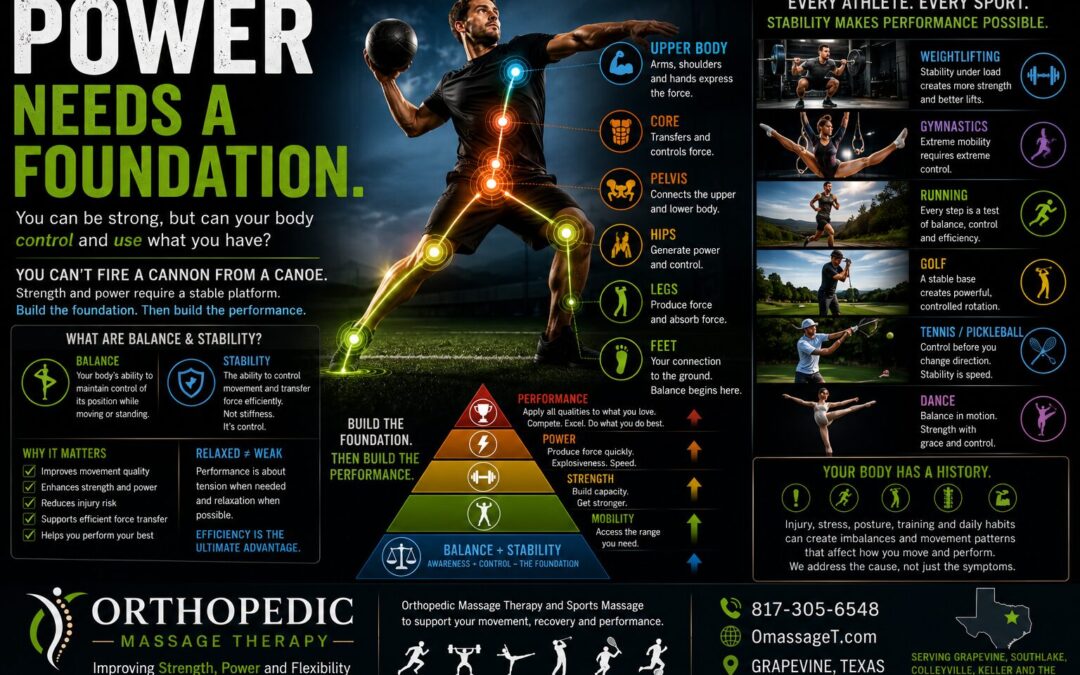
Improving Strength, Power and Flexibility Through Better Movement
When people think about improving their physical performance, they often focus on one thing.
They may want to become stronger.
They may want to become more flexible.
They may want to run faster, lift more weight or perform better in their sport.
All of those goals are important.
But strength, power and flexibility do not work independently.
They are connected through movement.
At OmassageT.com, my philosophy is:
Improving Strength, Power and Flexibility.
For me, this means looking at how the body moves as a whole and considering the relationship between mobility, flexibility, balance, stability and recovery.
Strength Is More Than Muscle
Strength is the ability to produce force.
But having strong muscles does not automatically mean that a person moves efficiently.
Strength needs to be coordinated with movement.
A person needs to control that strength.
They need to stabilize their body.
They need to move through appropriate ranges of motion.
This is especially important for athletes.
Power Is Different From Strength
Strength and power are related, but they are not exactly the same.
Power involves producing force quickly.
Running, jumping, changing direction and accelerating all require power.
An athlete can be strong but still need to develop the ability to use that strength quickly and efficiently.
Movement provides the connection.
Flexibility Is Only One Part of Movement
Flexibility refers to the ability of tissues and joints to move through a range of motion.
But being flexible does not automatically mean someone has good movement.
A person can have plenty of flexibility and still have difficulty controlling movement.
That is where stability and coordination become important.
Mobility and Flexibility Are Not the Same
Mobility and flexibility are often used as though they mean the same thing.
They are related, but there is an important distinction.
Flexibility generally describes the available range of motion.
Mobility involves being able to move through that range with control.
For everyday movement and athletic performance, both can matter.
Stability Gives Movement Control
Movement requires stability.
Your body has to create enough control to keep joints and body segments organized while you move.
Think about running.
Every time one foot leaves the ground, your body has to maintain control.
Think about reaching overhead.
Your shoulder moves, but your trunk also has to provide stability.
Think about lifting something.
Your legs, hips, pelvis and core all contribute.
Balance Is Part of Performance
Balance is another important part of movement.
Balance is not just standing on one foot.
It involves the body’s ability to control its position while moving.
Athletes use balance when changing direction.
Runners use balance with every stride.
Gymnasts use balance throughout their routines.
And everyone uses balance during normal daily activities.
Your Core Connects the Body
The core is more than the abdominal muscles.
It helps connect the upper and lower body.
The pelvis, diaphragm and surrounding structures all participate in the body’s core system.
When the core is functioning as part of coordinated movement, it can contribute to stability and control.
This is one reason I use the phrase:
Pain Relief by Improving/Repairing Core Performance.
The Pelvis Matters
The pelvis sits between the upper and lower body.
The hips connect to it.
The spine connects to it.
The legs move in relationship to it.
The pelvis therefore plays an important role in movement.
Changes in how someone sits, stands, walks or exercises can influence how the pelvis participates in movement.
That does not mean the pelvis is always the cause of pain.
It means it is an important part of the movement system.
Your Feet Are Part of the System
It is easy to overlook the feet when talking about strength and flexibility.
But the feet are where the body interacts with the ground.
They absorb forces.
They provide information.
They contribute to balance.
They help create movement.
The foot and ankle also influence what happens farther up the leg.
This is why a whole-body perspective can be useful.
Movement Patterns Can Change
Previous injuries can change movement.
Pain can change movement.
Daily habits can change movement.
Sports can change movement.
Sitting for long periods can change movement.
Sometimes the body adapts without us realizing it.
You may begin favoring one side.
You may change how you stand.
You may move differently during exercise.
Over time, those changes can become familiar movement patterns.
Why Old Injuries Matter
An injury does not necessarily stop affecting movement simply because the original pain has improved.
A person may continue to protect an area.
They may develop a different way of moving.
They may avoid certain positions.
They may rely more heavily on another part of the body.
This is one reason injury history can be important when considering current movement.
Better Movement Is Individual
There is no single perfect way for every person to move.
A competitive runner and someone recovering from an injury have different needs.
A high school football player has different demands from someone who spends most of the day at a desk.
An older adult may have different goals from a competitive athlete.
Better movement should be considered in the context of the individual.
Where Orthopedic Massage Fits
Orthopedic massage therapy can be one part of a larger approach to movement.
Massage does not build strength in the same way that resistance training does.
It does not replace physical therapy.
It does not replace athletic training.
It does not replace medical care.
Instead, massage may be used to address areas of soft-tissue tension and support comfortable movement.
Pain-Free Orthopedic Massage
My approach is pain-free orthopedic massage.
I do not believe massage needs to hurt to be effective.
The client should be comfortable enough to communicate throughout the session.
Pressure can be adjusted.
Positioning can be adjusted.
The work can be adapted to the individual.
Comfort is an important part of the process.
Fascia and Movement
Fascia is connective tissue that surrounds and connects structures throughout the body.
People sometimes describe restricted areas as feeling tight or “bound up.”
When appropriate, I may incorporate myofascial techniques into an orthopedic massage session.
The goal is not to force the body.
The goal is to work comfortably with areas that may be contributing to a person’s experience of restricted movement.
Mobility Before Performance
An athlete cannot simply train harder forever.
The body needs adequate mobility and recovery to support training.
If movement feels restricted, addressing mobility may become part of the overall plan.
This is where massage, stretching, mobility exercises, strength training and recovery strategies can complement one another.
Recovery Supports Performance
Performance is not only about what happens during training.
Recovery matters too.
Sleep matters.
Nutrition matters.
Hydration matters.
Rest matters.
Mobility matters.
Managing training volume matters.
Massage may be another tool that fits into an individual’s recovery routine.
Strength, Power and Flexibility Work Together
Consider a runner.
They need strength to control each stride.
They need mobility to move through the running pattern.
They need stability to control the body.
They need flexibility appropriate to their activity.
They need power when accelerating.
They need recovery between training sessions.
These qualities work together.
The Same Principle Applies to Everyday Life
You do not have to be an athlete to benefit from better movement.
You need movement to:
-
Walk
-
Sit
-
Stand
-
Bend
-
Reach
-
Lift
-
Turn
-
Climb stairs
-
Carry groceries
-
Work
-
Sleep comfortably
Movement is part of everyday life.
What Does “Better Movement” Mean?
Better movement does not necessarily mean moving farther.
It does not necessarily mean moving faster.
It does not mean being able to perform a complicated exercise.
Better movement can simply mean moving in a way that is more comfortable, controlled and appropriate for your body and your goals.
Some People Notice They Feel Taller
After an orthopedic massage session, some clients describe feeling taller.
I explain that massage does not literally make someone taller.
They may simply be experiencing a change in posture, tension, comfort or body awareness.
When the body feels more open and balanced, the person may perceive themselves differently.
Some people describe this as feeling “taller.”
Some People Describe Feeling Like They Are Floating
Another description I have heard is that someone feels like they are floating.
Again, this is an individual sensation.
It may reflect how different the body feels after a session.
Feeling lighter, more relaxed or more open can change the way someone experiences movement.
Balance and Stability Support Strength
Strength is not just about how much weight you can lift.
You need stability to use strength effectively.
For example, an athlete may have strong legs but still need good balance and control when changing direction.
A person lifting weights needs to stabilize their body while producing force.
Strength becomes more useful when the body can control it.
Flexibility and Strength Should Work Together
Flexibility without control is not the same as functional movement.
Strength without adequate mobility can also create challenges.
The goal is not to maximize one quality while ignoring the others.
The body needs an appropriate combination.
Improving Movement Takes Time
There is no universal timeline for improving movement.
A person’s age, activity level, injury history, health, training and goals all matter.
Some changes may feel noticeable quickly.
Other improvements require consistent work over time.
Movement is something the body learns and practices.
A Whole-Body Approach
When I work with someone, I do not want to view the body as a collection of unrelated parts.
The feet connect to the legs.
The legs connect to the hips.
The hips connect to the pelvis.
The pelvis connects to the core and spine.
The upper body contributes to balance and movement.
This does not mean that every problem originates somewhere else.
It means the body works together.
Improving Strength, Power and Flexibility at OmassageT.com
My goal at OmassageT.com is to help people understand that movement is more than simply stretching or strengthening one area.
It is about how the body works together.
Strength.
Power.
Flexibility.
Mobility.
Balance.
Stability.
Recovery.
These qualities can support one another.
Pain Relief by Improving Core Performance
This is why Pain Relief by Improving/Repairing Core Performance is an important part of my philosophy.
Rather than looking only at where someone feels discomfort, I consider how the body participates in movement.
Orthopedic massage can be one part of that process.
Other forms of exercise, rehabilitation and healthcare may also be appropriate depending on the individual.
Your Movement Matters
Whether you are an athlete, a runner, a weekend exerciser or simply someone who wants to move more comfortably, your movement matters.
Your body is designed to move.
The goal is not perfection.
The goal is to support movement that is comfortable, controlled and appropriate for you.
Orthopedic Massage Therapy in Grapevine, Texas
At OmassageT.com, I provide pain-free orthopedic massage therapy in Grapevine, Texas with a focus on whole-body movement, mobility, balance, stability, strength, power and flexibility.
OmassageT.com
110 S Barton #6
Grapevine, Texas 76051
817-305-6548
Improving Strength, Power and Flexibility
Pain Relief by Improving/Repairing Core Performance