Why People Sometimes Feel Like They Are Floating After a Session
Have you ever finished a massage session, stood up, and felt almost like you were floating?
Some people describe feeling lighter, more open, relaxed, balanced, or as if their body is moving with less effort. It can be a surprising sensation, especially when they expected to simply feel relaxed after a massage.
At OmassageT.com, I have had clients describe this kind of experience after orthopedic massage therapy. While everyone responds differently, the feeling can be connected to changes in how the body is moving, how much tension it is holding, and how a person experiences their own balance and movement.
The sensation is not necessarily about becoming physically lighter. It may be about feeling less restricted and more comfortable in your body.
What Does “Feeling Like You Are Floating” Mean?
When a client tells me they feel like they are floating, I don’t interpret that as meaning their body has physically changed weight.
Instead, it can be a way of describing a change in body awareness.
They may notice:
-
Less muscular tension
-
Easier movement
-
A greater sense of balance
-
More comfortable posture
-
Improved awareness of their body
-
A feeling of being more open
-
Easier breathing
-
A sense that movement requires less effort
Sometimes people simply say, “I feel lighter.”
These sensations can be difficult to describe because movement and body awareness are highly individual.
Tension Can Change How Your Body Feels
Your body is constantly responding to the demands placed on it.
Sitting for long periods, standing for work, exercising, recovering from an injury, repeating the same movements, or simply living with discomfort can influence how you hold your body.
You may not consciously realize that you are creating extra tension.
You might tighten your shoulders.
You might shift your weight onto one leg.
You might brace your abdominal muscles.
You might change the way you walk.
You might even change the way you breathe.
Over time, these patterns can become normal enough that you stop noticing them.
When some of that tension decreases, the difference can feel significant.
That is one reason someone may describe feeling lighter or as if they are floating after a session.
Balance Plays an Important Role
Balance is not just standing on one foot.
Your body is constantly making small adjustments to keep you upright and moving efficiently.
Your feet, ankles, knees, hips, pelvis, spine, shoulders, and head all participate in maintaining balance.
If one part of the body is uncomfortable or restricted, another part may compensate.
That compensation can change how you distribute your weight.
When movement becomes more comfortable, you may notice that your body feels more centered.
You may feel more stable when you stand.
You may walk differently.
You may feel as though you are not working as hard to maintain your position.
That can contribute to the feeling of floating.
Stability and the Core
Your core is much more than your abdominal muscles.
Core performance involves how your trunk, pelvis, hips, spine, and other parts of the body work together to support movement.
A stable body does not mean a rigid body.
Good movement requires the ability to stabilize when necessary while still allowing appropriate movement.
This is why I pay attention to the relationship between the core, pelvis, hips, and spine when working with clients.
If the body is constantly trying to protect or compensate for one area, movement can become less efficient.
A whole-body approach looks at how these areas are participating in movement rather than automatically focusing only on the place where someone feels pain.
Relaxation Can Change Movement
Relaxation is another important part of the experience.
When someone is uncomfortable, the body may naturally become protective.
Muscles may tighten.
Breathing may become shallower.
Movement may become more cautious.
A person may avoid certain positions without even realizing it.
A pain-free orthopedic massage approach gives the client an opportunity to relax without intentionally creating additional pain.
As the body becomes more comfortable, some people may notice that they can move with less effort.
That can create a feeling of lightness.
It can also change how a person experiences their body immediately after the session.
Breathing and the Diaphragm
Breathing is closely connected to movement.
The diaphragm is an important muscle involved in breathing, and breathing also interacts with the movement of the trunk and core.
When people are tense or uncomfortable, they may change their breathing patterns.
They may hold their breath during certain movements or breathe more shallowly.
When they relax, they may notice that breathing becomes easier or deeper.
That change alone can make someone feel different.
A fuller, more comfortable breath can contribute to the sensation of being open through the chest, ribs, abdomen, and torso.
For some people, that may be part of what they describe as feeling lighter or like they are floating.
Fascia and Myofascial Release
Fascia is another part of my approach.
Fascia is connective tissue that surrounds and supports muscles and other structures throughout the body. Areas of restriction can sometimes contribute to a feeling that movement is limited or “bound up.”
Myofascial release is one technique that may be used to address areas of restricted movement.
The goal is not simply to chase the place where a person feels pain.
Instead, I look at how the body is moving and where restrictions may be influencing that movement.
When movement feels freer, a person may experience their body differently.
That may be described as feeling lighter, more open, taller, or even as if they are floating.
These are individual experiences, not guaranteed outcomes.
Why People May Feel More Open
One of the comments I sometimes hear from clients is that they feel more open after a session.
They may feel more space through their shoulders or chest.
Their hips may feel easier to move.
Their posture may feel more natural.
They may notice that they are standing with less effort.
These sensations can all contribute to a person’s perception of lightness.
It does not necessarily mean that something dramatic has physically changed.
Sometimes a relatively small change in comfort or movement awareness can feel surprisingly significant.
Athletes Can Experience This Too
Athletes are constantly asking their bodies to produce movement.
Running, jumping, cutting, lifting, throwing, and changing direction require coordination between mobility, flexibility, balance, stability, strength, and power.
When an athlete has been training hard or compensating for an old injury, movement can become less comfortable.
Recovery work may help the athlete become more aware of how their body feels.
Some athletes may describe feeling more open or balanced afterward.
Others may say they feel lighter.
That does not mean the massage has magically increased athletic ability.
It may simply mean the athlete is noticing a difference in comfort, movement, or body awareness.
The Importance of Pain-Free Orthopedic Massage
My approach to orthopedic massage is pain-free.
I believe comfort and communication are important parts of treatment.
More pressure does not automatically mean better results.
If someone is already experiencing pain or guarding, intentionally creating more pain may not be the right approach for that individual.
Instead, I work with the client and adjust positioning, pressure, and techniques based on what the body is communicating.
This allows the session to remain focused on comfortable movement and the individual goals of the client.
Feeling Lighter Does Not Mean Your Weight Changed
It is worth making one distinction clear.
When someone says, “I feel lighter,” they are usually describing a sensation, not a measurable change in body weight.
Likewise, when someone says, “I feel taller,” it does not mean their bones became longer.
And when someone says, “I feel like I’m floating,” it does not mean they are physically defying gravity.
These expressions can describe how differently the body feels after a session.
The body may feel more comfortable.
Movement may feel easier.
Balance may feel different.
Muscular tension may feel reduced.
The person may simply be more aware of how their body feels.
Looking at the Whole Body
This is one reason I believe a whole-body approach matters.
The body does not move as a collection of completely separate parts.
The feet affect how we stand.
The legs affect how we walk.
The hips and pelvis participate in movement.
The core provides support and stability.
The spine responds to movement throughout the body.
The shoulders and head adjust to maintain balance.
When you look at the entire movement system, you can begin to understand why a change in one area may influence how the whole body feels.
That is the foundation of my approach to orthopedic massage therapy.
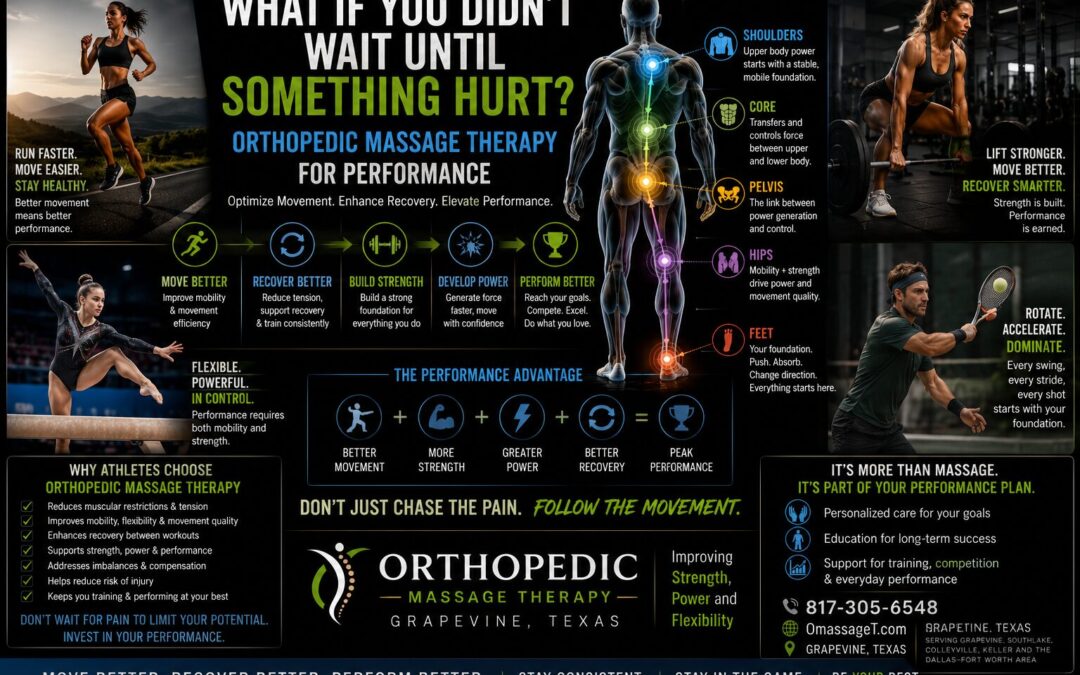
Improving Strength, Power and Flexibility
My philosophy is centered around:
Improving Strength, Power and Flexibility.
But these qualities don’t exist independently.
Strength can help support movement.
Power allows the body to produce movement quickly and effectively.
Flexibility allows available range of motion.
Mobility is the ability to actively move through that range.
Balance and stability help the body control movement.
When these qualities work together, movement can feel more natural and coordinated.
That is also why I use the phrase:
Pain Relief by Improving/Repairing Core Performance.
The goal is to look beyond the painful area and consider how the body is functioning as a whole.
What You May Notice After Your Session
Everyone’s response to massage is different.
You may feel relaxed.
You may feel more mobile.
You may notice better awareness of your posture.
You may feel balanced.
You may feel taller.
You may feel more open.
Or you may simply feel like you are floating.
There is no single sensation that everyone should expect.
The important thing is to pay attention to how your body feels and moves.
If you notice a meaningful change, communicate that with your therapist. Your feedback can help guide future sessions and make the work more individualized.
Massage Is Complementary Care
Orthopedic massage therapy is complementary care. It is not a replacement for medical diagnosis, physical therapy, rehabilitation, or other healthcare when those services are appropriate.
Persistent, severe, unexplained, or worsening symptoms should be evaluated by an appropriate healthcare professional.
Massage also does not guarantee that pain or movement problems will be resolved.
The purpose of this approach is to support comfortable movement and help clients better understand how their bodies feel and move.
A Different Way to Think About the “Floating” Feeling
The next time someone tells you they feel like they are floating after a massage, there may be a simple way to understand what they mean.
They may not be floating.
They may simply feel less restricted, more relaxed, more balanced, and more comfortable in their own body.
And sometimes, that difference can be remarkable.
Orthopedic Massage Therapy in Grapevine, Texas
At OmassageT.com, I provide pain-free orthopedic massage therapy with an emphasis on whole-body movement, balance, stability, mobility, strength, power, and flexibility.
OmassageT.com
110 S Barton #6
Grapevine, Texas 76051
817-305-6548
Improving Strength, Power and Flexibility
Pain Relief by Improving/Repairing Core Performance