
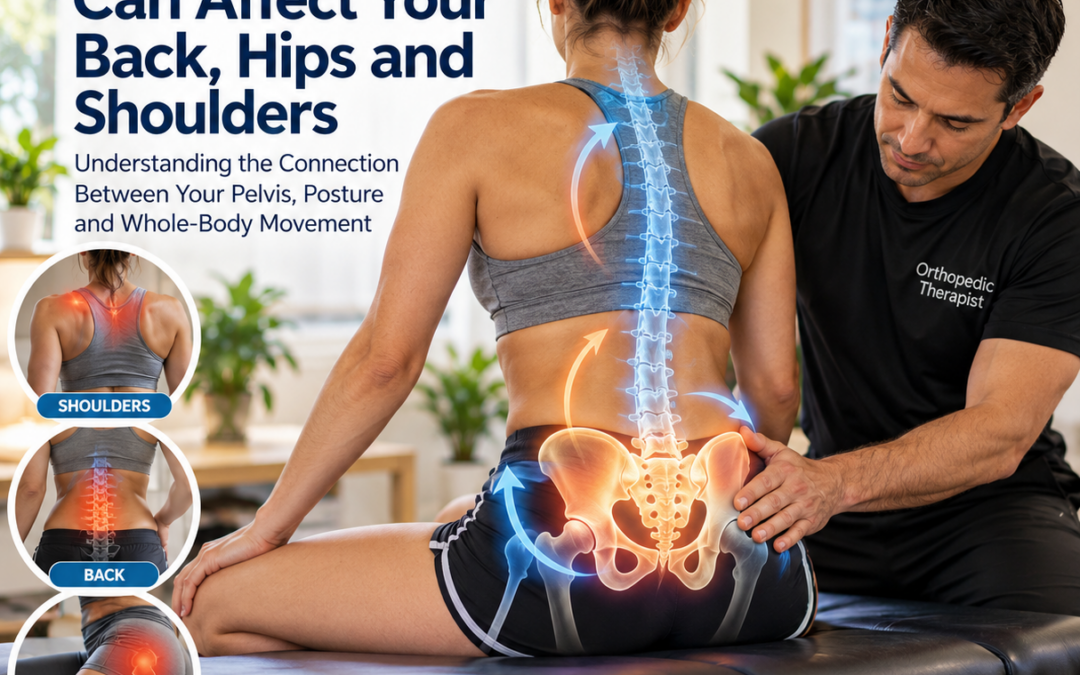
How Your Pelvis Can Affect Your Back, Hips, and Shoulders
OmassageT.com | Orthopedic Massage Therapy in Grapevine, Texas
Improving Strength, Power and Flexibility
Have you ever experienced shoulder pain that keeps returning, even after receiving treatment directly on your shoulder? Or perhaps you’ve struggled with lower back pain, tight hips, or discomfort between your shoulder blades without understanding why.
The source of discomfort isn’t always where you feel the pain.
One area that deserves attention is the pelvis. Your pelvis plays an important role in supporting your spine, transferring force between your upper and lower body, and helping you maintain balance and stability during everyday movement.
When movement around the pelvis becomes restricted or your body develops compensating movement patterns, the effects may extend beyond your hips and lower back.
At OmassageT.com in Grapevine, Texas, orthopedic massage therapy focuses on understanding how different areas of the body work together—not simply addressing the location of discomfort.
Understanding the Pelvis: Your Body’s Foundation for Movement
The pelvis connects your spine to your lower extremities. It helps distribute forces during walking, running, lifting, bending, and standing.
Several important muscles and connective tissues influence pelvic movement and stability, including:
-
Iliopsoas: Helps flex the hip and influences movement between the spine, pelvis, and thigh.
-
Quadratus lumborum (QL): Assists with spinal stabilization and side bending.
-
Gluteal muscles: Support hip movement, pelvic control, and stability.
-
Hamstrings: Contribute to hip extension and influence pelvic positioning.
-
Abdominal muscles: Help control the trunk and support movement.
-
Pelvic floor and diaphragm: Work with the abdominal wall and deep trunk muscles to help regulate pressure and support trunk function.
These structures work together during everyday activities. If one area becomes restricted, painful, or less effective, other areas may compensate.
This doesn’t mean every back or shoulder problem originates in the pelvis. It means that evaluating movement around the pelvis may reveal contributing factors that are easy to overlook.
1. How Pelvic Movement Can Influence Lower Back Pain
Lower back discomfort is one of the most common reasons people seek massage therapy.
The relationship between your lumbar spine, hips, and pelvis is especially important because these structures share the demands of movement and load-bearing.
For example, when the hips don’t move comfortably, the lower back may take on additional movement during bending, squatting, or reaching.
Some people experience:
-
Tightness across the lower back
-
Discomfort when transitioning from sitting to standing
-
Stiffness after long periods of sitting
-
Difficulty bending or rotating comfortably
-
Muscle fatigue after standing or walking
At OmassageT.com, orthopedic massage may address soft-tissue restrictions in the hip flexors, gluteal muscles, lower back, and surrounding fascia.
The goal is to support comfortable movement while considering how the body functions as a whole.
2. The Connection Between Your Pelvis and Hip Pain
Hip discomfort isn’t always caused by a problem within the hip joint itself.
The muscles surrounding the pelvis help control the position and movement of the femur, or thigh bone.
When these muscles become overworked, sensitive, or restricted, everyday movements may become uncomfortable.
For runners and athletes, the relationship between the pelvis and hips is particularly important.
Running involves repeatedly transferring body weight from one leg to the other. The gluteal muscles, hip stabilizers, and trunk muscles help control this movement.
If movement or control becomes limited, an athlete may develop compensating patterns that increase demands on other tissues.
Orthopedic massage therapy may help reduce muscle tension and improve tolerance for movement as part of a broader recovery or rehabilitation program.
3. Can Your Pelvis Affect Your Shoulders and Upper Back?
This connection often surprises people.
Your shoulders and pelvis are connected through the trunk, including the spine, abdominal muscles, back muscles, and surrounding connective tissue.
When you walk, your pelvis and upper body coordinate rotational movements. Your arms naturally swing while your trunk helps control balance.
If hip or trunk movement becomes restricted, you may compensate through the upper back or shoulders.
For example, someone with limited hip rotation may use additional trunk movement during certain activities.
Over time, this can contribute to muscle fatigue or discomfort, although shoulder pain can also have many unrelated causes.
At OmassageT.com, evaluating the pelvis, trunk, and hips alongside the shoulder may help identify movement patterns worth addressing.
The goal isn’t simply to relax a tight shoulder. It’s to understand what may be contributing to the tension.
4. Why Previous Injuries May Still Affect Your Movement
An old injury may continue to influence how someone moves long after the original discomfort has improved.
Consider someone who previously injured an ankle, knee, hip, or thigh.
During recovery, that person may have temporarily changed how they walked, stood, or transferred weight.
Sometimes those compensating patterns persist, particularly if strength, mobility, or confidence in the injured area has not fully returned.
The body may begin placing greater demands on other muscles or joints.
This is one reason a history of previous injuries can be valuable when evaluating current movement limitations.
At OmassageT.com, understanding past injuries helps guide an individualized orthopedic massage session.
5. The Pelvis, Pregnancy, Childbirth, and Changes in Movement
Pregnancy and childbirth can produce significant changes in the muscles and tissues supporting the abdomen, pelvis, and lower back.
During pregnancy, the body adapts to changes in weight distribution, abdominal muscle function, and physical demands.
Following childbirth, some individuals experience changes in trunk strength, hip mobility, pelvic floor function, or movement confidence.
Cesarean delivery also involves surgical healing and may leave scar-related sensitivity or restrictions.
These changes can sometimes influence how someone lifts, carries, walks, or performs daily activities.
Gentle, individualized soft-tissue work may help address muscular discomfort, but persistent pelvic floor symptoms, significant pain, or postoperative concerns deserve evaluation by an appropriately qualified healthcare professional.
Orthopedic massage can complement—not replace—pelvic health physical therapy or medical care when needed.
6. How Fascia Connects the Pelvis to the Rest of Your Body
Fascia is connective tissue that surrounds and supports muscles, nerves, blood vessels, and other structures throughout the body.
It helps tissues move relative to one another and contributes to the body’s structural organization.
The pelvis contains extensive fascial connections with the abdominal wall, hips, lower back, and thighs.
Following injury, surgery, or prolonged periods of reduced movement, tissues may develop stiffness or sensitivity.
Myofascial release techniques use sustained, controlled pressure or movement to address soft-tissue discomfort and restrictions.
While research continues to examine the precise mechanisms of myofascial techniques, some people experience short-term improvements in pain and range of motion.
At OmassageT.com, fascia is considered alongside muscle function, mobility, and overall movement patterns.
7. Why Pain-Free Orthopedic Massage Matters
Many people believe that effective massage must involve intense pressure or discomfort.
That isn’t necessarily true.
At OmassageT.com, the approach emphasizes pain-free orthopedic massage therapy.
When treatment is comfortable, clients may find it easier to relax and participate in gentle movements or positioning techniques.
Rather than forcing tissues through painful pressure, sessions can focus on comfortable soft-tissue techniques and observing how the body responds.
Every client has different needs, medical considerations, and movement goals.
The objective is to help support better mobility, comfort, and function without making treatment unnecessarily painful.
8. Improving Balance, Stability, and Core Performance
Your core involves much more than your abdominal muscles.
It includes coordinated activity among the diaphragm, abdominal wall, spinal muscles, pelvic floor, and muscles surrounding the hips.
These structures help support balance, control movement, and transfer forces throughout the body.
When the hips and pelvis move comfortably, it may be easier to perform activities such as:
-
Walking and running
-
Standing and changing positions
-
Reaching and rotating
-
Lifting and exercising
-
Maintaining balance during daily activities
Orthopedic massage may help address soft-tissue discomfort that limits these activities. Lasting improvements in strength and stability often also require appropriate exercise and movement training.
At OmassageT.com, the philosophy of Improving Strength, Power and Flexibility reflects the importance of looking at the body as an interconnected system.
9. When Should You Consider Orthopedic Massage Therapy?
If you’ve been experiencing recurring muscular discomfort or restricted movement, an orthopedic massage session may be worth considering.
You may benefit from an individualized assessment of soft-tissue restrictions if you notice stiffness in the hips, tension in the lower back, discomfort associated with exercise, or difficulty moving comfortably.
Orthopedic massage can also be considered as a complementary approach during recovery from certain injuries, with appropriate medical guidance.
However, persistent or worsening pain, new weakness or numbness, or symptoms following a significant injury should be medically evaluated. New bowel or bladder control problems, saddle numbness, or rapidly progressing leg weakness require urgent medical attention.
Orthopedic Massage Therapy in Grapevine, Texas
At OmassageT.com, we believe movement is about more than individual muscles.
The pelvis, spine, hips, shoulders, and surrounding connective tissues work together to support everyday activity.
Understanding these relationships may help identify soft-tissue restrictions and movement patterns that contribute to discomfort.
Whether you’re an athlete working toward improved performance, someone managing recurring muscle tension, or an individual seeking more comfortable movement, orthopedic massage therapy may be one part of your wellness and recovery plan.
Your pain may be in one location, but understanding your movement means looking at the bigger picture.
Schedule Your Orthopedic Massage Session
OmassageT.com — Orthopedic Massage Therapy
110 S Barton #6
Grapevine, Texas 76051
Call or text: 817-305-6548
Website: OmassageT.com
Improving Strength, Power and Flexibility
