
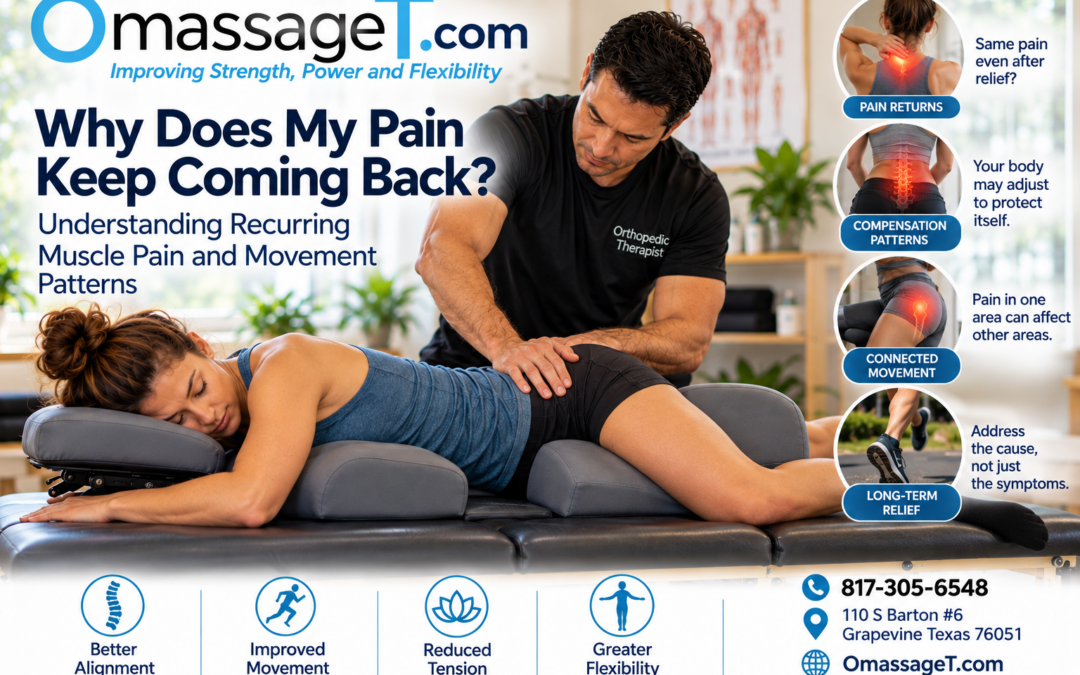
Why Does My Pain Keep Coming Back? Understanding Recurring Muscle Pain and Movement Patterns
Orthopedic Massage Therapy in Grapevine, Texas | OmassageT.com
Improving Strength, Power and Flexibility
Have you ever experienced relief from lower back pain, shoulder tension, or hip discomfort, only to have the same problem return days or weeks later?
Perhaps you’ve tried stretching, resting, massage, or changing your daily activities. You feel better for a while, but eventually, the discomfort returns.
This can be frustrating, especially when you don’t understand why it keeps happening.
One possible explanation is that the factors contributing to your discomfort haven’t fully changed.
Your body relies on coordinated movement between muscles, joints, connective tissues, and the nervous system. When an area becomes painful or restricted, you may unconsciously adjust how you move.
These adjustments can sometimes continue after the initial discomfort improves.
At OmassageT.com in Grapevine, Texas, orthopedic massage therapy takes a whole-body approach to muscular discomfort, considering movement, previous injuries, flexibility, balance, and stability.
Understanding these relationships can be an important part of managing recurring pain.
1. Why Does Muscle Pain Return After Treatment?
There are several reasons muscular discomfort may return after a period of improvement.
For example, someone experiencing neck tension from prolonged computer work may feel better after massage but develop similar symptoms after returning to the same work routine.
A runner may experience temporary relief from hip discomfort but continue to have difficulty controlling movement during training.
Someone recovering from an old injury may still have limitations in strength or mobility.
Recurring discomfort can involve:
-
Repetitive movements or sustained positions
-
Previous injuries and incomplete rehabilitation
-
Muscle fatigue or weakness
-
Reduced mobility or movement tolerance
-
Training demands that exceed current capacity
-
Stress, sleep, and nervous system sensitivity
Sometimes, an underlying medical condition may also contribute to recurring pain.
This is why understanding the history and characteristics of the discomfort is important.
Massage may help relieve symptoms, but lasting improvement often requires addressing other relevant factors as well.
2. Your Pain Location May Not Tell the Whole Story
One of the most important concepts in orthopedic massage therapy is understanding that the location of discomfort doesn’t always identify every contributing factor.
For example, someone experiencing lower back discomfort may also have limited hip mobility.
During bending or lifting, reduced movement at the hips can change how much movement occurs through the lumbar spine.
Similarly, an individual with shoulder discomfort may have reduced trunk rotation or difficulty coordinating shoulder blade movement.
These relationships don’t mean that every painful shoulder originates in the hips or that every back problem begins in the pelvis.
Instead, they illustrate why evaluating movement beyond the painful area can sometimes be helpful.
At OmassageT.com, the emphasis is on considering the body as a connected system.
3. How Your Pelvis and Core Influence Recurring Back Pain
Your pelvis connects your spine to your lower extremities and plays an important role in transferring forces during everyday movement.
The muscles surrounding your pelvis and trunk help control activities such as walking, standing, bending, and lifting.
These include the gluteal muscles, abdominal muscles, hip flexors, spinal stabilizers, diaphragm, and pelvic floor.
When someone experiences lower back discomfort, these structures may be relevant to how they move.
For example, limited hip mobility or reduced trunk endurance may influence the demands placed on the lower back during certain activities.
However, there is no single ideal pelvic position or posture that guarantees freedom from pain.
People naturally have different movement patterns and body structures.
The goal is to identify limitations that are meaningful to the individual’s symptoms and activities.
Orthopedic massage may help address muscular discomfort around the hips, pelvis, and lower back, while exercise and movement training may be needed to improve strength and endurance.
4. Why Old Injuries Can Contribute to Recurring Pain
Previous injuries can sometimes influence movement long after the original injury has healed.
Imagine someone who experienced a quadriceps injury while playing sports.
During recovery, they may have temporarily changed how they walked, ran, or lifted their leg.
If hip mobility or strength remains limited, they may continue moving differently during certain activities.
Over time, these adjustments can affect the demands placed on surrounding muscles and joints.
A similar situation can occur after ankle injuries, knee injuries, or periods of reduced activity following surgery.
Not every compensation pattern causes pain, and the presence of an old injury does not prove that it is responsible for new symptoms.
However, understanding previous injuries can provide useful information when evaluating recurring muscular discomfort.
5. The Role of Fascia in Recurring Muscle Tightness
Fascia is connective tissue that surrounds and supports muscles, nerves, blood vessels, and other structures throughout your body.
It contributes to the organization of tissues and helps neighboring structures glide during movement.
Following injury, surgery, or prolonged inactivity, tissues may become sensitive or less mobile.
Some individuals describe this sensation as tightness, stiffness, or a feeling that their muscles are bound together.
These sensations can involve fascia, muscles, the nervous system, and other structures.
Myofascial release is a manual therapy technique that uses controlled pressure and gentle movements to address soft-tissue discomfort.
Some people experience short-term improvements in pain and range of motion following myofascial treatment.
However, research has not established that these techniques permanently break apart deep fascial adhesions or eliminate the underlying causes of recurring pain.
At OmassageT.com, myofascial release can be incorporated into a comfortable orthopedic massage session based on individual needs.
6. Why Stretching Alone May Not Stop Pain From Returning
Stretching can be useful for improving range of motion and reducing the sensation of muscle tightness.
However, it may not address every factor contributing to recurring discomfort.
For example, someone with persistent hip tightness may also have reduced hip strength or limited control during single-leg activities.
Stretching may temporarily improve comfort without changing those additional factors.
Similarly, someone with recurring shoulder tension may benefit from examining work habits, activity demands, shoulder mobility, and muscle endurance.
A comprehensive approach may include appropriate stretching, strengthening, movement practice, and recovery strategies.
Orthopedic massage can complement these approaches by helping manage soft-tissue discomfort.
7. Why Pain-Free Orthopedic Massage Can Be Helpful
Some people assume that deep pressure and painful treatment are necessary to resolve stubborn muscle tension.
That isn’t necessarily true.
At OmassageT.com, the approach emphasizes pain-free orthopedic massage therapy.
Comfortable treatment allows clients to communicate about their symptoms and participate in gentle movement or positioning techniques.
This may be particularly helpful for people with sensitive tissues, chronic muscular discomfort, or limitations following an injury.
Treatment can include myofascial release, soft-tissue massage, and individualized positioning.
The objective is to support relaxation, improve comfort, and help clients move more freely without unnecessary pain.
8. Why Athletes Experience Recurring Muscle Discomfort
Athletes repeatedly expose their bodies to demanding movements.
Running, sprinting, jumping, lifting, and changing direction require coordinated activity throughout the body.
When training demands increase faster than the body can adapt, muscle soreness and discomfort may develop.
Previous injuries, inadequate recovery, reduced strength, and training errors may also contribute.
For runners, recurring hip or lower-extremity discomfort may be associated with several factors, including training load and individual movement characteristics.
For football players and other competitive athletes, repeated high-intensity activities place substantial demands on muscles and connective tissues.
Sports massage and orthopedic massage may help manage soreness and support relaxation.
However, preventing recurring sports injuries generally requires appropriate conditioning, load management, and rehabilitation when necessary.
9. The Relationship Between Stress, Sleep, and Chronic Pain
Pain isn’t influenced only by muscles and joints.
The nervous system plays an important role in how discomfort is experienced.
Poor sleep, ongoing stress, and insufficient recovery can affect pain sensitivity and the body’s ability to tolerate physical demands.
Some individuals notice that their muscle tension feels worse during particularly stressful periods.
Others experience greater discomfort following several nights of poor sleep.
Massage may help promote relaxation and temporarily reduce perceived muscle tension.
However, persistent sleep problems or chronic pain may require additional support from healthcare professionals.
A whole-body approach considers these factors alongside movement and soft-tissue health.
10. Improving Balance, Stability, and Movement
At OmassageT.com, the philosophy of Improving Strength, Power and Flexibility reflects the importance of comfortable, coordinated movement.
Balance and stability depend on the interaction between the nervous system, muscles, joints, and sensory information.
When discomfort limits activity, addressing muscular tension may help someone participate more comfortably in exercise or rehabilitation.
Some clients describe feeling more relaxed, open, or comfortable in their posture after a massage session.
These experiences may reflect temporary changes in muscle tension, movement perception, or relaxation rather than a permanent structural change.
Long-term improvements in physical capacity often require regular movement, strengthening, and appropriate conditioning.
11. When Should You Seek Help for Recurring Pain?
If the same discomfort continues returning, it may be useful to consider whether additional evaluation is needed.
Orthopedic massage may be appropriate for certain types of muscular tension and movement-related discomfort.
However, recurring pain should not automatically be attributed to muscle tightness or compensation patterns.
Pain that is persistent, worsening, unexplained, or accompanied by weakness, numbness, fever, or other concerning symptoms should be evaluated by a qualified healthcare professional.
New bowel or bladder dysfunction, saddle numbness, or rapidly progressive weakness requires urgent medical attention.
Understanding the possible causes of recurring discomfort helps guide safer, more appropriate care.
Orthopedic Massage Therapy in Grapevine, Texas
Recurring pain can be frustrating, particularly when temporary relief doesn’t seem to last.
Sometimes, improving comfort involves more than working directly on the painful area.
Previous injuries, movement limitations, muscular sensitivity, physical demands, and recovery habits may all be relevant.
At OmassageT.com, orthopedic massage therapy emphasizes a comfortable, individualized approach that considers the body as an interconnected movement system.
Whether you’re an athlete managing recurring soreness, someone experiencing persistent muscular tension, or an individual seeking more comfortable movement, orthopedic massage may be a helpful part of your overall care.
Relieving discomfort is valuable. Understanding what may contribute to its return can be just as important.
Schedule Your Orthopedic Massage Session
OmassageT.com — Orthopedic Massage Therapy
110 S Barton #6
Grapevine, Texas 76051
Call or text: 817-305-6548
Website: OmassageT.com
Improving Strength, Power and Flexibility
