
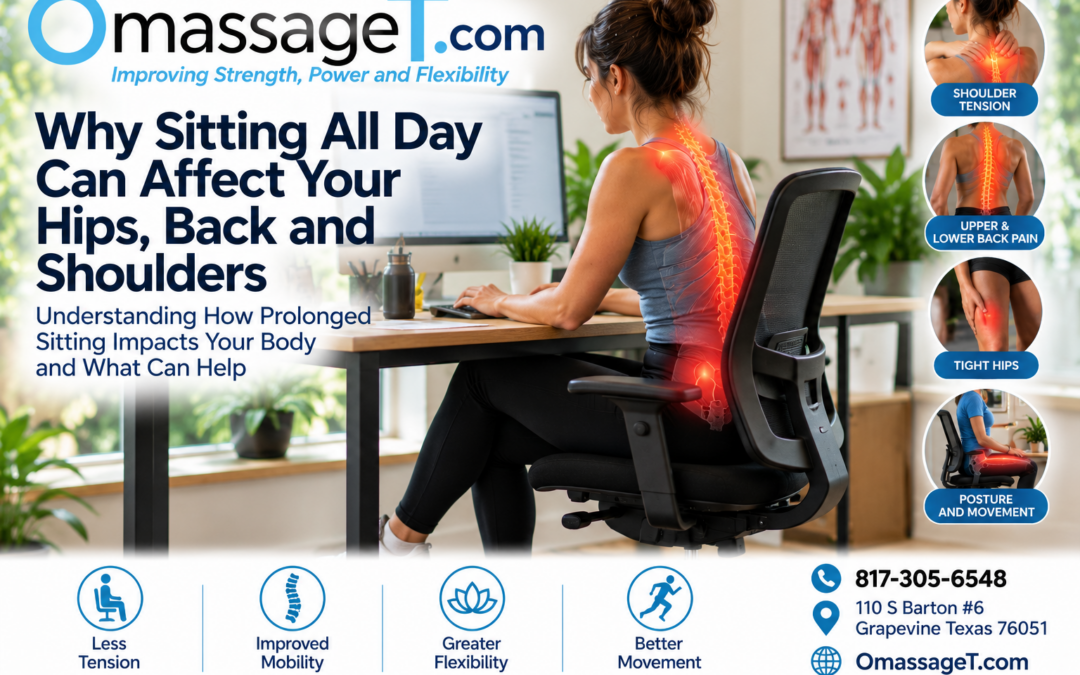
Why Sitting All Day Can Affect Your Hips, Back, and Shoulders
Orthopedic Massage Therapy in Grapevine, Texas | OmassageT.com
Improving Strength, Power and Flexibility
Do you spend hours sitting at a desk, working on a computer, driving, or watching television? Have you noticed that your lower back feels stiff when you stand up, your hips feel tight, or your shoulders become uncomfortable by the end of the day?
You’re not alone.
Many people spend a significant portion of their day sitting. Although sitting itself is not inherently harmful, remaining in one position for extended periods can contribute to stiffness, muscular fatigue, and discomfort.
Your body is designed to move through a variety of positions throughout the day.
When movement becomes limited, certain muscles and joints may feel less comfortable, particularly when transitioning from sitting to standing or performing physical activities.
At OmassageT.com in Grapevine, Texas, orthopedic massage therapy focuses on understanding how muscles, connective tissues, and movement patterns work together.
Rather than looking only at the location of discomfort, we consider how the hips, pelvis, spine, and shoulders may contribute to comfortable movement.
1. What Happens to Your Body When You Sit for Long Periods?
Sitting involves flexion at the hips and knees while the trunk remains supported in a relatively stationary position.
Several muscles help maintain this position, including the hip flexors, abdominal muscles, spinal muscles, and muscles surrounding the pelvis.
During prolonged sitting, some tissues remain in relatively shortened positions while others experience sustained loading.
This doesn’t necessarily damage the muscles or permanently shorten them.
However, remaining in one position for too long can increase the sensation of stiffness or fatigue.
Some people experience discomfort when they first stand up after sitting for several hours.
Moving around, walking, or gently changing positions often helps.
The important factor isn’t finding one perfect sitting posture. It’s giving your body opportunities to move regularly.
2. Why Your Hip Flexors May Feel Tight After Sitting
Your hip flexors are muscles that help bring your thigh toward your trunk.
Important hip flexors include the iliacus, psoas major, and rectus femoris.
When sitting, your hips remain flexed for extended periods.
After standing, some individuals experience tightness or discomfort around the front of the hips.
This sensation doesn’t necessarily mean the hip flexors have physically shortened.
Muscle sensitivity, reduced movement tolerance, and other factors can contribute.
If hip extension becomes uncomfortable or limited, someone may change how they walk, stand, or perform certain exercises.
Orthopedic massage may help address soft-tissue discomfort around the hips as part of a broader approach to improving mobility.
3. The Connection Between Sitting, Your Pelvis, and Lower Back Pain
Your pelvis connects your spine to your lower extremities and plays an important role in movement.
When sitting, the pelvis and lumbar spine adapt to the position of the chair and the way you distribute your weight.
Some people prefer sitting upright, while others feel more comfortable reclining or changing positions frequently.
There is no single ideal pelvic position that prevents back pain.
However, prolonged sitting without movement can contribute to discomfort, particularly in individuals who already experience lower back sensitivity.
For example, someone with limited hip mobility may find certain sitting positions uncomfortable.
Another person may experience muscle fatigue from maintaining an upright position for too long.
At OmassageT.com, orthopedic massage sessions may address muscular tension around the lower back, hips, and pelvis.
The goal is to support comfortable movement rather than forcing the spine or pelvis into a particular alignment.
4. Why Sitting Can Contribute to Upper Back and Shoulder Tension
Your shoulders and upper back also respond to the demands of prolonged desk work.
Typing, using a mouse, reading, and looking at a screen require repeated or sustained activity from muscles surrounding the neck and shoulders.
These include the upper trapezius, levator scapulae, rhomboids, and other muscles involved in supporting the head and shoulder blades.
When these muscles remain active for extended periods, some individuals experience fatigue or discomfort.
For example, someone working on a laptop may repeatedly lean forward to see the screen.
This position isn’t automatically harmful, but maintaining it for hours without variation may become uncomfortable.
Adjusting the workstation, taking movement breaks, and changing positions can help reduce sustained muscular demands.
Orthopedic massage may also help manage associated soft-tissue discomfort.
5. Can Sitting Affect Your Diaphragm and Breathing?
The diaphragm is your primary breathing muscle.
It separates the chest cavity from the abdominal cavity and works with other respiratory muscles to support breathing.
Your diaphragm also contributes to trunk pressure regulation and interacts with the abdominal wall and pelvic floor.
Body position can influence breathing mechanics.
For example, some people find that sitting in a compressed or slouched position makes deep breathing feel less comfortable.
Changing position and practicing slow, comfortable breathing may help increase awareness of rib cage movement.
However, normal variations in sitting posture do not necessarily impair breathing.
If you experience persistent shortness of breath or unexplained breathing difficulty, seek medical evaluation rather than assuming the cause is muscular tightness.
6. How Fascia Responds to Reduced Movement
Fascia is connective tissue that surrounds and supports muscles, nerves, blood vessels, and other structures.
It contributes to the organization of tissues and helps neighboring structures glide during movement.
Following prolonged inactivity, some people notice increased stiffness or sensitivity.
These sensations may involve muscles, fascia, joints, and the nervous system.
Myofascial release is a manual therapy approach that uses controlled pressure and gentle movement to address soft-tissue discomfort.
Some individuals experience temporary improvements in pain or range of motion following treatment.
However, sitting does not necessarily cause fascia to become permanently stuck or hardened, and massage has not been shown to reliably break apart deep fascial adhesions.
At OmassageT.com, myofascial release may be incorporated into a pain-free orthopedic massage session when appropriate.
7. Why Your Core Matters When You Sit and Stand
Your core includes more than your abdominal muscles.
It involves coordinated activity among the abdominal wall, diaphragm, spinal muscles, pelvic floor, and muscles surrounding the hips.
These structures contribute to trunk control during sitting, standing, walking, and lifting.
When transitioning from sitting to standing, your body coordinates movement through the hips, knees, ankles, and trunk.
If one area is painful or restricted, the movement may feel less comfortable.
For example, reduced hip strength or knee discomfort may make standing from a low chair more difficult.
Massage may help manage associated muscular tension, but improving strength and functional capacity often requires appropriate exercise.
At OmassageT.com, the philosophy of Improving Strength, Power and Flexibility reflects the importance of considering how different areas contribute to movement.
8. Why Athletes Who Sit All Day May Experience Stiffness
Even active individuals can experience discomfort after prolonged sitting.
A runner may train in the morning but spend the remainder of the day working at a desk.
A football player may sit through hours of classes before practice.
Someone who regularly lifts weights may spend much of their workday driving.
Sitting does not automatically undo the benefits of exercise.
However, prolonged periods without movement may increase stiffness or make the transition into intense physical activity feel uncomfortable.
Athletes can benefit from regular movement breaks, appropriate warm-ups, and consistent strength and mobility training.
Sports massage and orthopedic massage may help manage muscular soreness and support relaxation as part of a broader recovery plan.
9. Why Pain-Free Orthopedic Massage Can Help
Some people assume that stubborn muscle tightness requires aggressive pressure.
That isn’t necessarily true.
At OmassageT.com, the approach emphasizes pain-free orthopedic massage therapy.
Comfortable techniques allow clients to communicate openly and participate in gentle positioning or movement.
Sessions may include soft-tissue massage, myofascial release, and individualized approaches based on areas of discomfort.
The objective is to support relaxation and comfortable movement without unnecessary pain.
10. Five Simple Ways to Feel Better During a Long Workday
General movement suggestions for otherwise healthy adults; adjust to your comfort and medical needs.
Change positions regularly. Rather than trying to maintain perfect posture, alternate between comfortable sitting positions and standing when practical.
Take short walking breaks. Walking for a few minutes periodically can help interrupt long periods of inactivity.
Move your shoulders and neck. Gentle shoulder rolls and comfortable neck movements may help reduce the sensation of stiffness.
Practice comfortable hip movement. Standing hip extensions, short walks, or gentle mobility exercises can help introduce movement after sitting.
Breathe slowly and comfortably. Taking a moment to relax and allow natural rib cage movement can help reduce the feeling of tension.
The goal is not to perform a complicated routine.
It’s to give your body opportunities to move throughout the day.
11. When Should You Seek Help for Sitting-Related Pain?
Occasional stiffness after prolonged sitting is common.
However, persistent or worsening pain deserves attention.
If discomfort interferes with work, sleep, exercise, or daily activities, an appropriate healthcare evaluation may help identify contributing factors.
Symptoms such as progressive weakness, persistent numbness, or unexplained pain should not automatically be attributed to posture or muscle tension.
New bowel or bladder dysfunction, saddle numbness, or rapidly progressive leg weakness requires urgent medical attention.
Orthopedic massage may be helpful for some types of muscular discomfort, but it is not a substitute for medical diagnosis or treatment.
Orthopedic Massage Therapy in Grapevine, Texas
Sitting is a normal part of everyday life.
The challenge often comes from spending too much time in one position without giving your body opportunities to move.
Your hips, pelvis, spine, shoulders, and surrounding connective tissues work together during everyday activities.
When muscular discomfort or restricted movement develops, understanding these relationships may help guide a more individualized approach.
At OmassageT.com, orthopedic massage therapy emphasizes pain-free techniques and a whole-body perspective.
Whether you work at a desk, spend hours driving, or simply want to move more comfortably, orthopedic massage may be one component of your wellness and recovery plan.
Your body doesn’t need perfect posture. It needs comfortable movement and opportunities to change positions.
Schedule Your Orthopedic Massage Session
OmassageT.com — Orthopedic Massage Therapy
110 S Barton #6
Grapevine, Texas 76051
Call or text: 817-305-6548
Website: OmassageT.com
Improving Strength, Power and Flexibility
