
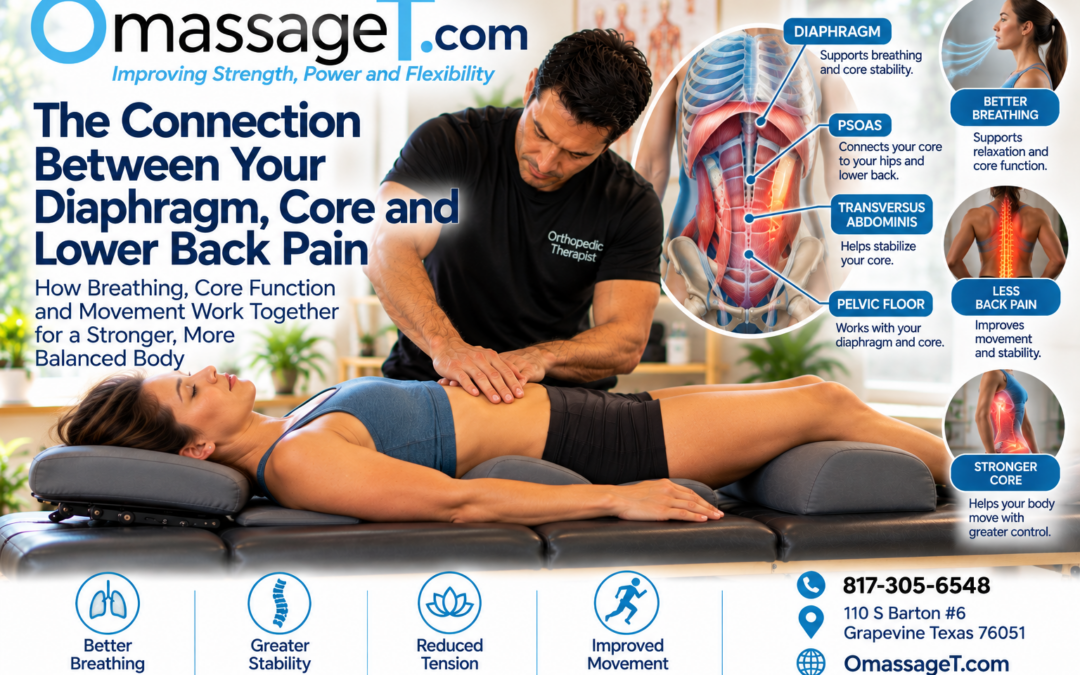
The Connection Between Your Diaphragm, Core, and Lower Back Pain
Orthopedic Massage Therapy in Grapevine, Texas | OmassageT.com
Improving Strength, Power and Flexibility
Have you ever considered that the way you breathe might influence how your back, shoulders, and core muscles function?
Most people think of breathing as something that happens automatically. We breathe throughout the day without giving much thought to the muscles involved.
But breathing is more than moving air in and out of your lungs.
Your diaphragm works with your abdominal muscles, pelvic floor, and muscles surrounding your spine to help regulate pressure and support trunk stability.
These relationships are especially interesting when considering lower back discomfort, restricted movement, and muscle tension.
At OmassageT.com in Grapevine, Texas, orthopedic massage therapy focuses on understanding how different areas of the body work together.
Rather than looking only at where someone feels discomfort, we consider how breathing, muscle function, movement, and previous injuries may contribute to the overall picture.
1. What Is the Diaphragm, and Why Is It Important?
The diaphragm is a dome-shaped muscle located beneath your lungs.
It separates your chest cavity from your abdominal cavity and serves as the primary muscle of breathing.
When you inhale, the diaphragm contracts and moves downward, increasing the space inside your chest so your lungs can expand.
As you exhale, the diaphragm relaxes and moves upward.
The diaphragm attaches to the lower ribs, sternum, and lumbar spine through specialized structures.
Because of these anatomical connections, it participates in a system that supports both breathing and trunk function.
Although breathing is its primary responsibility, the diaphragm also contributes to regulating pressure inside the abdomen.
This pressure regulation can help support the spine during certain activities.
2. Your Core Is More Than Your Abdominal Muscles
When people hear the word core, they often think about abdominal exercises.
However, your core involves several muscles working together to control trunk movement and stability.
Important contributors include:
-
Diaphragm: Supports breathing and contributes to abdominal pressure regulation.
-
Transversus abdominis: Helps control abdominal tension and trunk movement.
-
Multifidus: Small muscles that contribute to spinal control.
-
Pelvic floor: Supports pelvic organs and participates in pressure regulation.
-
Internal and external obliques: Help control trunk rotation and bending.
-
Quadratus lumborum (QL): Contributes to side bending and lumbar stability.
-
Psoas major: Connects the lumbar region to the thigh and helps control hip movement.
These muscles do not function independently.
They coordinate with the nervous system and other structures during standing, walking, lifting, and exercise.
If one area becomes painful or less effective, other muscles may adjust their activity.
However, not every muscle imbalance produces pain, and there is no single ideal pattern of core muscle activation for everyone.
3. How Breathing and Lower Back Pain May Be Connected
Lower back pain is a complex condition with many possible contributing factors.
In some individuals, breathing patterns and trunk muscle coordination may be relevant.
Research has identified differences in respiratory muscle function or breathing mechanics in certain groups of people experiencing persistent lower back pain.
However, these findings do not establish that poor breathing causes lower back pain.
The relationship may work in both directions.
Pain can influence muscle activity and breathing, while changes in breathing and trunk coordination may affect how certain movements feel.
For example, someone experiencing lower back discomfort may unconsciously brace their abdominal muscles during movement.
This can change the way they breathe while lifting or bending.
Learning to coordinate comfortable breathing with movement may be useful as part of an individualized rehabilitation program.
Orthopedic massage may help address associated muscular tension, but it is not a substitute for evaluating persistent back pain.
4. The Connection Between the Diaphragm, Psoas, and Lumbar Spine
The psoas major is a deep muscle that extends from the lumbar spine and nearby structures to the upper thigh.
It contributes to hip flexion and helps control movement around the hip and trunk.
The diaphragm attaches to the lumbar region through structures known as the crura.
These anatomical relationships place the diaphragm and psoas within the same general region of the body.
However, their proximity does not mean that tightness in one muscle automatically causes dysfunction in the other.
When someone experiences hip or lower back discomfort, it may be useful to consider both hip mobility and trunk function.
For example, limited hip extension may influence how someone walks or performs certain exercises.
Similarly, pain around the lumbar spine may change how someone braces their trunk.
At OmassageT.com, the focus is on evaluating relevant movement restrictions and muscular discomfort rather than assuming that one muscle is responsible for every symptom.
5. How the Quadratus Lumborum Influences Movement and Stability
The quadratus lumborum, commonly called the QL, is located in the posterior abdominal wall.
It extends between the pelvis, lumbar vertebrae, and lower rib.
This muscle contributes to side bending, stabilization of the lumbar region, and control of the twelfth rib during breathing.
Some individuals experience muscular discomfort in the region of the QL, particularly following demanding physical activities or prolonged positions.
However, pain in this area can also arise from other muscles, joints, nerves, or medical conditions.
Gentle soft-tissue techniques may help reduce muscular discomfort when appropriate.
The objective is to support comfortable movement rather than assuming the QL is always tight or needs to be released.
6. The Diaphragm and Pelvic Floor: Working Together
The diaphragm and pelvic floor participate in the regulation of pressure inside the abdominal cavity.
During breathing, these structures respond to changes in pressure and movement.
When you inhale, the diaphragm descends and abdominal pressure changes.
The pelvic floor can respond to these pressure changes through coordinated muscular activity.
During exhalation, the diaphragm relaxes upward.
This relationship is important during activities such as lifting, coughing, walking, and exercising.
However, pelvic floor dysfunction can involve many factors and cannot be diagnosed solely by observing someone’s breathing.
People experiencing pelvic pain, urinary leakage, or other pelvic floor symptoms may benefit from evaluation by a pelvic health professional.
Orthopedic massage can complement appropriate care for surrounding muscular discomfort but does not replace specialized pelvic floor assessment or treatment.
7. Why Sitting All Day May Influence Breathing Comfort
Many people spend hours sitting at desks, driving, or working on computers.
Prolonged sitting can contribute to feelings of stiffness, especially when someone remains in the same position for extended periods.
Certain seated positions may also make deep breathing feel less comfortable.
For example, someone who sits with their trunk compressed may notice that taking a full breath feels different than when standing upright.
This doesn’t mean that slouched sitting damages the diaphragm or prevents normal breathing.
Rather, body position can influence how the rib cage and abdominal wall move.
Changing positions regularly and taking comfortable movement breaks can help reduce the demands of prolonged sitting.
8. Can Breathing Influence Neck and Shoulder Tension?
Although the diaphragm is the primary breathing muscle, other muscles can assist breathing when respiratory demands increase.
These include muscles around the neck and upper chest, such as the scalenes and sternocleidomastoid.
During strenuous activity or respiratory difficulty, these accessory muscles may become more active.
Some people with persistent neck discomfort also experience altered breathing patterns, although the relationship is not necessarily causal.
Gentle breathing exercises may help certain individuals relax and become more aware of muscle tension.
However, persistent neck or shoulder pain should not automatically be attributed to breathing mechanics.
A healthcare evaluation may be necessary to identify other possible causes.
9. How Fascia Connects the Diaphragm to Surrounding Structures
Fascia is connective tissue that surrounds and supports muscles, nerves, blood vessels, and other structures.
The diaphragm has connective tissue relationships with structures in the chest, abdomen, and lumbar region.
These connections contribute to the organization and mechanical function of surrounding tissues.
Following injury, surgery, or prolonged inactivity, some individuals may experience soft-tissue sensitivity or reduced movement tolerance.
Myofascial release techniques use controlled pressure and gentle movements to address muscular and connective tissue discomfort.
Some people experience short-term improvements in pain or range of motion following treatment.
However, there is limited evidence that massage can directly release deep diaphragmatic attachments or permanently change the structure of fascia.
At OmassageT.com, myofascial techniques may be incorporated into a comfortable orthopedic massage session based on individual needs.
10. Why Pain-Free Orthopedic Massage Matters
One of the principles of OmassageT.com is that effective massage does not need to be painful.
Clients experiencing chronic muscle tension or movement restrictions may already have sensitive tissues.
Excessive pressure can increase discomfort and cause protective muscle activity.
A comfortable approach allows clients to relax and communicate throughout the session.
Treatment may include gentle soft-tissue massage, myofascial release, comfortable positioning, and guided movement when appropriate.
The goal is to support relaxation, muscular comfort, and improved movement tolerance.
11. Breathing, Athletic Performance, and Recovery
Breathing plays an essential role in physical activity.
During exercise, the respiratory system helps meet the body’s increased demand for oxygen and removal of carbon dioxide.
The diaphragm also participates in trunk pressure regulation during certain movements.
Athletes benefit from developing appropriate breathing strategies for their activities.
For example, breathing demands during endurance running differ from those during heavy resistance training.
There is no single breathing technique that is ideal for every sport or exercise.
Sports massage and orthopedic massage may help manage muscular soreness and promote relaxation, while conditioning and sport-specific training remain central to performance development.
12. A Simple Breathing Exercise for Relaxation
If you’re generally healthy and want to explore comfortable breathing, try this gentle exercise:
-
Sit or lie in a comfortable, supported position.
-
Relax your shoulders and jaw.
-
Place one hand on your lower ribs.
-
Inhale gently through your nose, allowing your lower ribs and abdomen to move naturally.
-
Exhale slowly without forcing the breath.
-
Repeat for several comfortable breaths.
Avoid holding your breath or forcing unusually deep inhalations.
If you feel dizzy, uncomfortable, or short of breath, stop the exercise.
This practice may help encourage relaxation and awareness of breathing movement, but it is not a treatment for unexplained breathing problems or persistent back pain.
Orthopedic Massage Therapy in Grapevine, Texas
Your diaphragm, abdominal muscles, pelvic floor, hips, and spine work together during everyday activities.
Understanding these relationships can provide useful insight into how your body supports breathing, movement, and stability.
At OmassageT.com, orthopedic massage therapy emphasizes a pain-free, individualized approach that considers the body as an interconnected movement system.
Whether you’re experiencing recurring muscular tension, lower back discomfort, or stiffness associated with daily activities, orthopedic massage may be a helpful part of a broader wellness or rehabilitation plan.
Comfortable breathing and comfortable movement are both important parts of physical well-being.
Schedule Your Orthopedic Massage Session
OmassageT.com — Orthopedic Massage Therapy
110 S Barton #6
Grapevine, Texas 76051
Call or text: 817-305-6548
Website: OmassageT.com
Improving Strength, Power and Flexibility
